Bad at carbonated drinks with 炭酸
Kanji Explanation: Sourness and acids with 酸
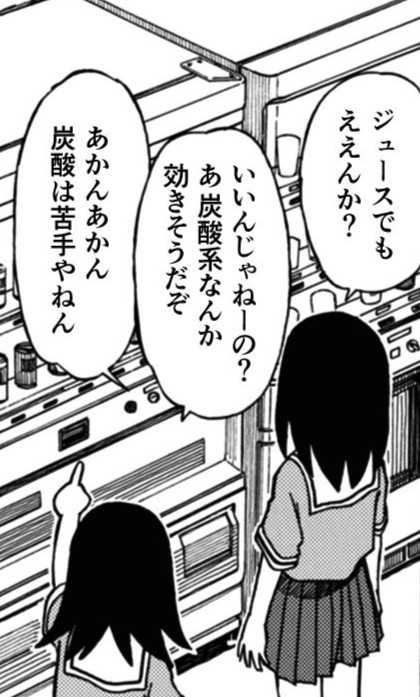
A case of the hiccups sends Ayumu down the path of trying each of her friends’ potential solutions. Tomo suggests drinking water as a cure.
- 歩:
- 「ジュースでもええんか?」
- “Is juice okay too?”
- とも:
- 「いいんじゃねーの?あ炭酸系なんか効きそうだぞ」
- “Yeah, that should be fine, right? Actually, carbonated stuff might work even better.”
- 歩:
- 「あかんあかん炭酸は苦手やねん」
- “No no, I can't do carbonated drinks. I'm bad with them.”
Key Points
1炭酸 and 炭酸系 mean carbonated drinks here
- 炭酸 is carbonic acid or carbonation. In this scene, both speakers use it for carbonated drinks.
- 炭酸系 means “the carbonated category”, so Tomo is suggesting carbonated drinks in general rather than one specific drink.
- You can parse 炭酸系なんか(が)効きそうだぞ as “something carbonated might work”; なんか gives an example and the subject marker が is left unstated.
2苦手 means “can’t handle”, not a lack of skill
- With food and drinks, 〜は苦手 says the speaker dislikes them or does not tolerate them well. Ayumu is not saying she lacks a skill.
- Here 炭酸は makes carbonated drinks the topic: “as for carbonated drinks, I can’t handle them.”
3Ayumu’s Kansai forms
- ええんか corresponds to standard いいのか, meaning “is it okay?”
- あかん means “no good”; 苦手やねん corresponds to standard 苦手なんだ and presents her difficulty with carbonated drinks as an explanation.
4いいんじゃねーの? = “That should be fine, right?”
- ねー is Tomo’s rough pronunciation of ない, so the fuller form is いいんじゃないの?.
- Despite its negative shape, the question seeks agreement with Tomo’s judgment rather than meaning “it isn’t fine”.
5効きそうだぞ = “it looks like it might work”
- The verb stem 効き plus そうだ expresses an impression or likelihood, not a known result.
- Sentence-final ぞ gives Tomo’s guess a blunt, confident push.
Vocabulary
炭酸 (Carbonation)
炭酸 means carbonic acid or carbonation. In everyday use, it often refers to carbonated water or a carbonated drink.
苦手 (Weak point)
苦手 means something one is bad at or someone one finds difficult to deal with.
See Also
- Kanji: Sourness and acids with 酸
- Grammar: Grammar in the Kansai dialect
- Future entry: Looking like with 〜そうだ
- Grammar: Negation with 〜ない
- Grammar: Offering an example with 〜でも
- Future entry: Rough declarations with ぞ and ぜ
- Kanji: Hands and skill with 手
あずまんが大王 © its respective creators. It is used here for educational commentary.