Because strong players gather here with 〜ので
Grammar Explanation: Objective reason with 〜ので
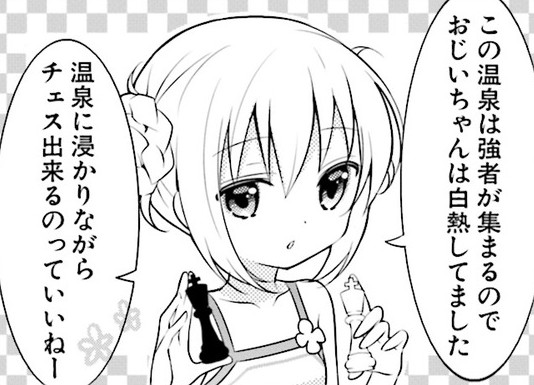
Cocoa inquires about the board and pieces sitting in front of Chino. Chino says it’s chess and gives a further explanation.
- チノ:
- 「この温泉は強者が集まるのでおじいちゃんは白熱してました」
- “Grandpa would get excited because strong players gather at this hot spring spa.”
- Literal: “Because strong players gather at this hot spring, Grandpa was getting fired up.”
- ココア:
- 「温泉に浸かりながらチェス出来るのっていいねー」
- “It's nice being able to play chess while soaking in the hot spring.”
Key Points
- Strong players gathering at the hot spring supplies the reason for おじいちゃんは白熱してました.
- この温泉は sets the location as the topic, while 強者が marks the players who gather there.
- In this chess context, 白熱してました, a casual 白熱していました, says Grandpa would become fired up or engrossed in the competition.
- 浸かる becomes 浸かり before ながら, so both activities happen at the same time.
Vocabulary
| Word | English | Meaning |
|---|---|---|
| この | This | この means “this” or “these” and comes directly before a noun. It points to something near the speaker or something the speaker is referring to in the conversation. |
| 温泉 | Hot spring | 温泉 means a natural hot spring, or the baths and resort area built around one. |
| 強者 | Strong contender | 強者 refers to someone who excels in strength, ability, or power, or who is in a position of strength. |
| 集まる | To gather | 集まる is for people or things to come together in one place. |
| おじいちゃん | Grandpa | おじいちゃん is a familiar word for one’s grandfather. People also use it for any elderly man. |
| 白熱 | White heat | 白熱 literally means glowing white from heat. Figuratively, 白熱する means to become heated, excited, or intensely absorbed in a contest or discussion. |
| 浸かる | To soak | 浸かる is to be in water up to a certain point, such as soaking in a bath. |
| チェス | Chess | チェス is chess, the board game. |
| 出来る | To be able to | 出来る means to be able to do something. It can also mean that something is made, completed, or comes into existence. |
| いい | Good | いい describes something good, nice, or fine. It can also mean “okay” or “that’s enough”. Its other forms come from よい, as in よくない and よかった. |
See Also
- Grammar: Objective reason with 〜ので
- Grammar: Past tense with 〜た・〜だ
- Grammar: Marking the topic with は and も
- Grammar: Concurrent events with 〜ながら
- Grammar: Seeking agreement with ね
- Grammar: Able to do with 〜れる・〜られる
- Kanji: Going out and emerging with 出
- Kanji: Strength and force with 強