Because this is chance encounter with 〜ので
Grammar Explanation: Objective reason with 〜ので
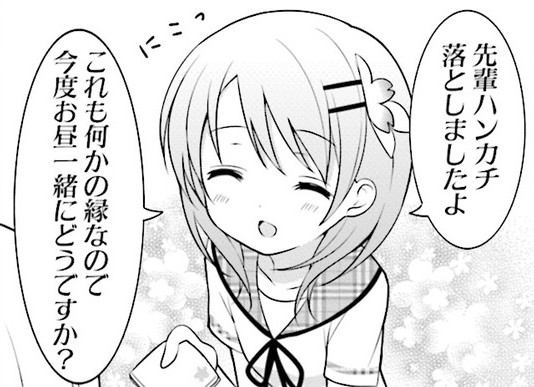
When Cocoa picks up another student’s dropped handkerchief, she uses the opportunity to show off her devilish nature to Chiya they discussed earlier.
- ココア:
- 「先輩ハンカチ落としましたよ」
- “Senpai, you dropped your handkerchief.”
- 「これも何かの縁なので今度お昼一緒にどうですか?」
- “How about we have lunch together next time, since this, too, is a meeting of chance?”
- Literal: “Since this too is some kind of connection, how about lunch together next time?”
Key Points
- Cocoa treats their meeting as 何かの縁, a connection brought about by chance, and uses it to support her invitation.
- これも means “this too”, and 何かの leaves the kind of connection vague instead of making the encounter sound fated.
- The omitted action is having lunch, so the line asks whether they would like to eat together next time.
Vocabulary
| Word | English | Meaning |
|---|---|---|
| 先輩 | Senior | 先輩 is a senior member of the same school, workplace, or group, usually someone who joined earlier or has more experience. |
| ハンカチ | Handkerchief | ハンカチ is a handkerchief, a small cloth for wiping hands or face. |
| 落とす | To drop | 落とす is to drop something. It also means to lose something by accident. |
| これ | This | これ points to something close to the speaker, or to the thing just mentioned. |
| 何か | Something | 何か means something or anything. It can also introduce an uncertain question, as in “Is something wrong?” |
| 縁 | Fate | 縁 is the bond or chance that brings people together. 何かの縁 means “fate must have brought us together”. |
| 今度 | This time | 今度 means “this time” or “next time”, depending on context. |
| お昼 | Lunch | お昼 is midday, or the meal eaten around noon. |
| 一緒に | Together | 一緒に describes doing something with someone else, at the same time or in the same place. |
| どう | How | どう asks about the way or state of something: “how” or “how about”. It also appears in どうしよう, “what should I do?” |
See Also
- Grammar: Objective reason with 〜ので
- Grammar: Marking the topic with は and も
- Grammar: Polite style with です and ます
- Grammar: Informing with よ
- Grammar: Consonant doubling with 促音
- Future entry: Transitivity in Japanese
- Kanji: Daytime and noon with 昼
- Kanji: Measures and degrees with 度
- Kanji: Now and the present with 今