Being innocent at school with 猫を被る
Idiom Explanation: Putting on an innocent act with 猫を被る
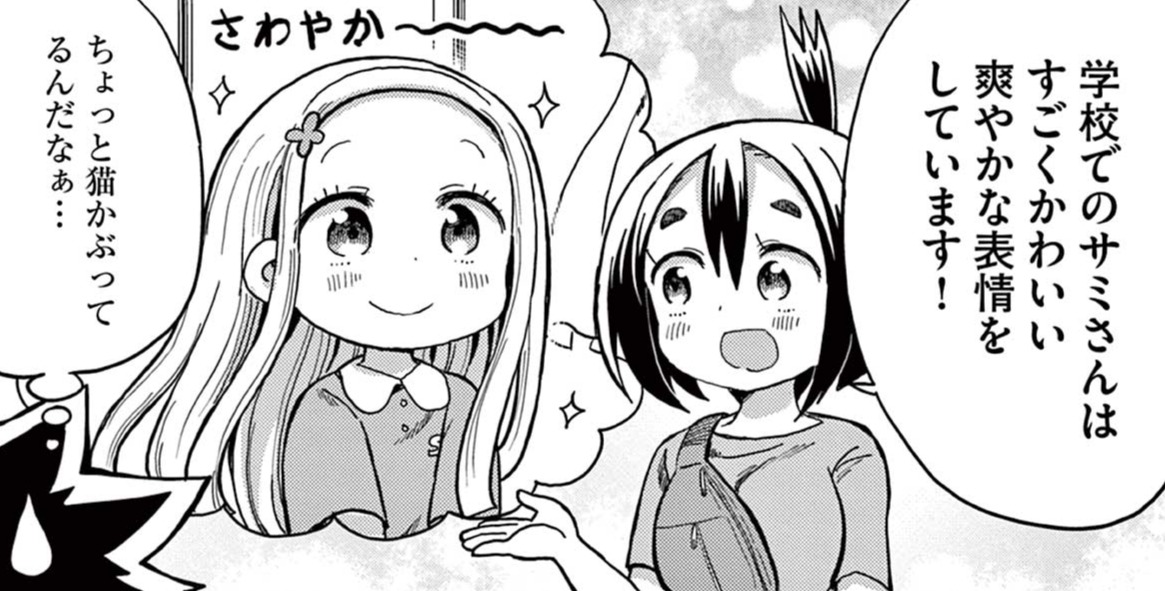
Sami and her father go to the park to play. There, they see Sami’s teacher. The teacher is surprised to see Sami’s rambunctious behavior, as it’s different from the Sami she sees at school.
- 先生:
- 「学校でのサミさんはすごくかわいい爽やかな表情をしています!」
- “At school, Sami has such a cute and delightful expression!”
- パパ:
- 「ちょっと猫かぶってるんだなぁ…」
- “She's just putting on a front, isn't she...”
Key Points
1猫を被る = “put on a front”
- This idiom means hiding one’s usual nature by acting innocent, quiet, or well-behaved. Here, Sami’s father says that the sweet demeanor her teacher sees at school is an act.
2Casual speech: 猫(を)かぶっている → 猫かぶってる
- The spoken form drops the object particle を and contracts 〜ている to 〜てる. The fuller wording is 猫をかぶっている.
- Here, 〜ている describes the front Sami maintains at school, rather than the literal act of putting on something at that moment.
3学校でのサミさん = “Sami as she is at school”
- Adding の after 学校で lets the location phrase modify サミさん. This wording sets her school persona against the more active Sami her teacher is seeing at the park.
4The father’s softened, reflective judgment
- ちょっと makes his criticism less blunt, like “just” or “a little” in the translation.
- Explanatory んだ presents the act as the reason for the difference, while なぁ sounds reflective.
- さん is an honorific suffix attached to a person’s name to show respect and social distance, roughly equivalent to “Mr.”, “Ms.”, or “Mrs.” in English, though it’s used far more broadly and doesn’t specify gender or marital status.
Vocabulary
学校 (School)
学校 means a school, where teachers provide organized instruction to students.
表情 (Facial expression)
表情 means a facial expression that shows someone’s feelings. Less commonly, it can describe the appearance or mood of a place or thing.
See Also
ぼくの魔なむすめ © its respective creators. It is used here for educational commentary.