Better to do light stretches before swimming with 〜た+方がいい
Grammar Explanation: Giving advice with 〜た+方がいい
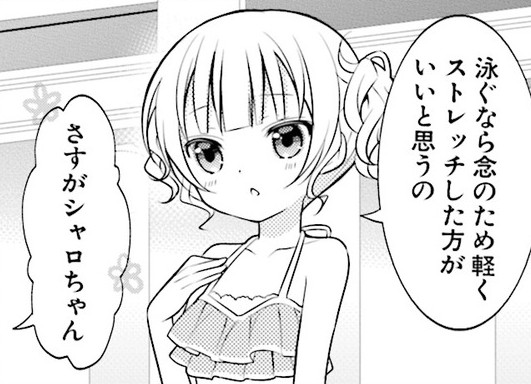
Before Cocoa teaches Rize how to swim, Syaro stops her with a suggestion.
- シャロ:
- 「泳ぐなら念のため軽くストレッチした方がいいと思うの」
- “If you're going to swim, I think you had better do some light stretching just in case.”
- Literal: “If you're going to swim, I think the direction of having done light stretching is good, just in case.”
- ココア:
- 「さすがシャロちゃん」
- “That's Syaro for you.”
Key Points
- Syaro recommends stretching before swimming; she does not compare two literal directions.
- する becomes した, but the recommendation concerns what the listeners should do next.
- と思う frames the advice as Syaro’s judgment, and 念のため gives the precautionary reason.
- さすが means Syaro has lived up to Cocoa’s favorable expectations.
Vocabulary
泳ぐ (To swim)
泳ぐ is to move through water by moving the arms and legs.
念のため (Just in case)
念のため describes doing something as a precaution.
軽い (Light)
軽い means light in weight. It can also describe something minor, mild, or easy to do.
ストレッチ (Stretching)
ストレッチ is stretching exercises that loosen the muscles.
する (To do)
する is to do or perform something. It also turns many nouns into verbs, as in 勉強する.
方 (Side)
方 is a direction or side. In comparisons, 〜方がいい means “it’s better to”. Read かた, it is a polite word for a person.
いい (Good)
いい describes something good, nice, or fine. It can also mean “okay” or “that’s enough”. Its other forms come from よい, as in よくない and よかった.
思う (Think)
思う is to have a thought, feeling, belief, or hope about something.
さすが (As expected)
さすが shows that someone did just as well as you would expect from them: “that’s so-and-so for you”.
See Also
- Grammar: Giving advice with 〜た+方がいい
- Grammar: If that's the case with なら
- Grammar: Quoting and reporting with と and って
- Grammar: Purpose and cause with 〜ために