Blooming the coffee grounds with お湯を注ぐ
Vocabulary Explanation: Collocations for cooking
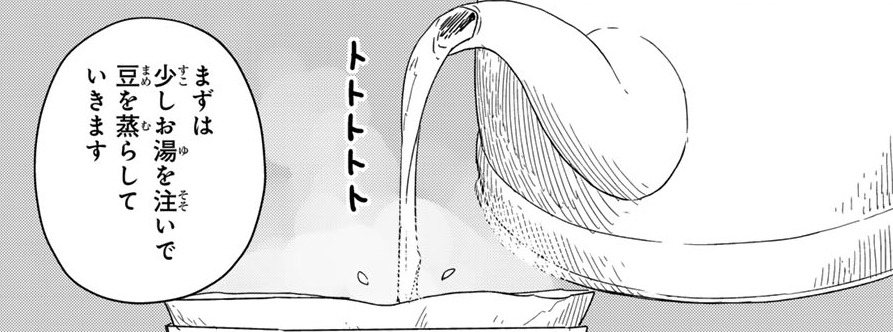
At a coffee shop, Makoto tastes a cup so good that she’s hooked on coffee. The owner sells her some beans and shows her how to brew them by hand. Back home, Makoto makes drip coffee for the household and walks them through each step as she goes.
- 真琴:
- 「まずは少しお湯を注いで豆を蒸らしていきます」
- “First, I pour in a little hot water and let the grounds bloom.”
- Literal: “First, pouring a little hot water, I'll go on steaming the beans.”
Key Points
- 注ぐ means to pour liquid into or onto something in a steady stream. It’s the usual verb for kettles, teapots, and instant noodles: お湯を注いで3分, “add hot water and wait three minutes”.
- お湯 is hot water. Japanese uses a separate word from 水, which means cold or room-temperature water, so お湯 is the noun that goes with a kettle.
- 注いで is the て-form. It links the pour to the next action: pour, and with that, let the grounds bloom.
- 蒸らす means to let food sit in its own steam. With rice, ご飯を蒸らす is leaving cooked rice covered for a few minutes so it finishes cooking.
- With drip coffee, it’s the bloom. A little hot water wets the grounds, they puff up and give off gas, and the main pour that follows extracts more evenly.
- 豆 literally means bean. Coffee talk uses it for both the whole beans and the grounds, so it refers here to the grounds in the filter.
- 〜ていく after a verb can show steps done one after another, with nobody moving anywhere. Cooking shows and demonstrations use it as they work: 切っていきます, “now I’ll cut it”.
- Her next line uses the same form: ゆっくり「の」の字を書くように注いでいきます, “then I pour slowly, as if writing the character の”.
- まず means first. Adding は sets up the first step as one of a sequence, so the listener expects more steps to follow.
Vocabulary
まず (First)
まず means first, before anything else, and often opens a list of steps. It is also written 先ず.
少し (A little)
少し describes a small amount or degree.
お湯 (Hot water)
お湯 is heated water. At a hot spring or bath, it also means the bath water itself.
注ぐ (To pour)
注ぐ means to pour a liquid into or onto something, such as hot water into a cup or over coffee grounds. It also means to devote energy or attention to something, as in 力を注ぐ. Read つぐ, it means to fill a cup or glass with a drink.
豆 (Bean)
豆 means a bean or pea, especially one used as food.
蒸らす (To steam; to let sit in its own steam)
蒸らす means to let food sit covered in its own steam so it finishes cooking, as with rice after the heat is turned off. In drip coffee, it is the first small pour that soaks the grounds before the main pour.
いく (To go)
いく is to move from where you are toward somewhere else. After a て-form verb, it shows an action continuing or progressing. It is the kana spelling of 行く.
See Also
- Vocabulary: Collocations for cooking
- Grammar: Coming and going with 〜てくる and 〜ていく
- Grammar: Connecting actions with 〜て・〜で