Bluish clothes with 〜っぽい
Grammar Explanation: Kind of like with 〜っぽい
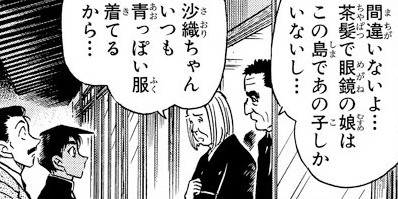
Naoko has been murdered during Sumi’s wake, and Kogoro tells the islanders that the killer took her Dugong Arrow, a sacred arrow from the island’s festival. Saori is missing, and she had also said she lost her arrow, so she may have been killed too. Then an elderly woman says she saw Saori near the Mermaid Falls on the morning of the festival, and other villagers say they spotted her there as well. Heiji asks whether it was really Saori.
- お爺さん:
- 「間違いないよ… 茶髪で眼鏡の娘はこの島であの子しかいないし…」
- “It was her, all right... She's the only girl on this island with brown hair and glasses...”
- お婆さん:
- 「沙織ちゃんいつも青っぽい服着てるから…」
- “And Saori always wears bluish clothes...”
Key Points
- After a color, っぽい means “-ish”. 青っぽい服 is clothes in blue tones, whatever the exact shade.
- 青っぽい is an い-adjective, so it goes straight before 服 with no な.
- The villagers only glimpsed the girl, some of them from a distance. A rough color is all they can give.
- 着てる is 着ている, with the い dropped in casual speech. With いつも, it describes a habit: “always wears”.
- The を after 服 is dropped too, as often happens in casual speech.
- The man ends with し, which gives one reason and leaves room for more. The woman supplies another with から, “because”.
- Both lines trail off. The point they’re leading to is the man’s first words, 間違いないよ, “It was her, all right.”
- あの子しかいない is “there is no one but that girl”. しか always pairs with a negative verb, here いない.
Vocabulary
間違いない (No doubt)
間違いない says something is certain, that there’s no mistake about it.
茶髪 (Brown hair)
茶髪 is hair dyed or bleached brown, or brown hair in general.
眼鏡 (Glasses)
眼鏡 means glasses or spectacles worn to correct vision, protect the eyes, or as an accessory.
娘 (Daughter)
娘 means daughter. Depending on context, it can also mean a girl or young woman.
この (This)
この means “this” or “these” and comes directly before a noun. It points to something near the speaker or something the speaker is referring to in the conversation.
島 (Island)
島 is an island, a piece of land surrounded by water.
あの (That)
あの comes before a noun to mean “that” or “those”. It points to someone or something away from both speakers, or something they both know about.
子 (Child)
子 is a child. It also means a young person or a young animal.
しか (Only)
しか means “only” or “nothing but”. It always pairs with a negative verb: 一つしかない is “there’s only one.”
いる (To be)
いる is to exist or be somewhere, for people and animals. After a て-form verb, it shows an ongoing action or a continuing state.
いつも (Always)
いつも describes what happens all the time, or what is normal for someone.
青っぽい (Bluish)
青っぽい describes a color close to blue, with a blue tint. Said of a person, it can also mean green or inexperienced.
っぽい (-ish)
っぽい follows a word to say something seems like it or tends toward it.
服 (Clothes)
服 is clothes, especially Western-style clothing.
着る (To wear)
着る is to put on or wear clothes on the upper body or whole body.
See Also
- Grammar: Kind of like with 〜っぽい
- Grammar: Because with 〜から
- Grammar: Ongoing actions and resulting states with 〜ている
- Grammar: Limiting with 〜だけ
- Grammar: How casual contractions work
- Kanji: Childhood and small things with 子
- Kanji: Clothing and submission with 服
- Kanji: Reflection and optics with 鏡
- Kanji: Seeing and insight with 眼
- Kanji: Spaces and intervals with 間
- Kanji: Tea and tea culture with 茶