Boiling eggs for Mother's Day with 卵をゆでる
Vocabulary Explanation: Collocations for cooking
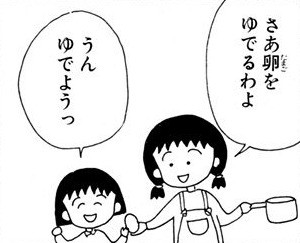
It’s Mother’s Day, and Maruko has a present ready for Mom. Her older sister suggests the two of them cook a feast to surprise her. She announces the menu, sandwiches, gratin, and dessert, and Maruko can’t believe she knows how to make all that.
- お姉ちゃん:
- 「さあ卵をゆでるわよ」
- “All right, we're going to boil the eggs!”
- まる子:
- 「うんゆでようっ」
- “Okay, let's boil them!”
Key Points
1卵をゆでる = boil eggs
- ゆでる (茹でる) means to cook something in boiling water, then take it out. Eggs, pasta, noodles, and vegetables are all ゆでる foods. を marks the eggs as what gets boiled.
- A boiled egg is a ゆで卵, whether soft or hard. Food that simmers in a seasoned broth is 煮る instead.
- The kanji 茹 is rare, so ゆでる is usually written in kana, as it is here.
2ゆでよう = let’s boil
- ゆでよう is the volitional form of ゆでる: drop る and add よう. Maruko uses it to agree and join in, “let’s boil them”.
- Her sister says the plain ゆでる. With さあ at the start, the plain form announces what the two of them are about to do.
3わよ = feminine よ
- わよ is よ with the feminine particle わ in front. The sister uses it to tell Maruko what comes next, the way a parent or teacher might.
- さあ is said when starting something or urging someone along: “all right”, “come on”.
Vocabulary
卵 (Egg)
卵 is an egg, especially a chicken egg used as food. It also means a person still in training, as in 医者の卵, a future doctor.
ゆでる (To boil)
ゆでる is to cook food in boiling water and then take it out, as with eggs, noodles, or vegetables. It is also written 茹でる.
See Also
- Vocabulary: Collocations for cooking
- Grammar: Volitional with 〜う・〜よう
- Grammar: Informing with よ
ちびまる子ちゃん © its respective creators. It is used here for educational commentary.