Boiling water for the projectionist's tea with お湯を沸かす
Vocabulary Explanation: Collocations for cooking
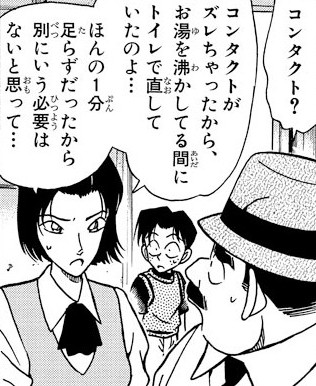
During a screening at an old movie theater, a man is found hanged in front of the projection window. Yuriko, who works the theater’s snack counter, says she was in the projection booth making tea for the projectionist when his shadow appeared on the screen. Mitsuhiko then says he saw her pressing her eyes in front of the mirror in the women’s restroom just before that. When Inspector Megure asks why she wasn’t in the booth, she stammers that it was her contact lens.
- 目暮:
- 「コンタクト?」
- “Your contact lens?”
- 百合子:
- 「コンタクトがズレちゃったから、お湯を沸かしてる間にトイレで直していたのよ…」
- “My contact lens slipped, so I fixed it in the restroom while the water was heating up...”
- Literal: “Because my contact slipped out of place, while I was boiling hot water, I was fixing it in the restroom...”
- 「ほんの1分足らずだったから別にいう必要はないと思って…」
- “It took less than a minute, so I didn't think I needed to mention it...”
Key Points
- 沸かす means to bring a liquid to a boil. Japanese names the result, so you boil お湯, “hot water”, not 水, “cold water”. English says “boil water” for the same action.
- 沸かす is transitive: someone heats the water. Its intransitive partner is 沸く: お湯が沸いた, “the water’s boiling.”
- The projectionist asked for tea a page earlier, and he says she was boiling water for it: 湯を沸かしてたんだよな? Yuriko’s line repeats the phrase with the polite お.
- 沸かしてる is 沸かしている with the い dropped. It describes the water heating as an ongoing action.
- 間に marks a span of time in which a second action happens. She fixed her lens during the time it took the water to heat.
- ズレる means to shift out of its proper position. With a contact lens, it means the lens slid off the center of the eye.
- 〜ちゃった is the casual form of 〜てしまった. It frames the slip as something that happened to her, not something she meant to do.
- 直す means to fix or put right. Here she puts the lens back in place.
- のよ gives an explanation in a feminine register. She is answering Megure’s question about why she wasn’t where she said she was.
- 足らず after an amount means “less than”. 1分足らず is under a minute.
- ほんの stresses how small the amount is. She plays down her absence as too short to be worth mentioning.
- 別に〜ない means “not particularly”. 別にいう必要はない means “there was no particular need to say it.”
Vocabulary
コンタクト (Contact lenses)
コンタクト is short for コンタクトレンズ, contact lenses. It also means getting in touch with someone.
ズレる (To slip out of place)
ズレる means to shift away from where something should be, such as a contact lens sliding off center or glasses slipping down the nose. It also describes timing or opinions that are slightly off. It is also written ずれる.
お湯 (Hot water)
お湯 is heated water. At a hot spring or bath, it also means the bath water itself.
沸かす (To boil)
沸かす means to heat a liquid until it boils, as in お湯を沸かす, “boil water”. It also means to heat a bath, and to stir a crowd to excitement.
間 (While)
間 is the space or time between two things. 〜の間 means “while” or “during”.
トイレ (Toilet; restroom)
トイレ means a toilet or restroom.
直す (To fix)
直す is to repair or correct something. After a verb stem, it means to redo the action.
ほんの (Just a)
ほんの comes before an amount to stress how small it is, as in ほんの少し, “just a little”.
一分 (One minute)
一分 means one minute. Read いちぶ, it means one tenth or one percent.
足らず (Less than)
足らず follows an amount to mean “just under” it, as in 1分足らず, “less than a minute”.
別に (Not particularly)
別に means “not particularly” when used with a negative. Said alone, it means “nothing in particular” or “it doesn’t matter”.
いう (To say)
いう is to put something into words. It is the kana spelling of 言う and appears in phrases like という, which introduces a name or a quoted idea.
必要 (Necessity)
必要 is something being needed for a purpose. 必要ない says there is no need, and 必要がある says there is one.
ない (Not)
ない means something does not exist or someone does not have it. After a verb, it makes the verb negative. It is also written 無い.
思う (Think)
思う is to have a thought, feeling, belief, or hope about something.
See Also
- Vocabulary: Collocations for cooking
- Future entry: Transitivity in Japanese
- Grammar: During the same time with 〜間(に)
- Grammar: Ongoing actions and resulting states with 〜ている
- Grammar: Doing completely or ending up doing with 〜てしまう and 〜ちゃう
- Grammar: Because with 〜から
- Grammar: Reasoning with 〜のだ
- Grammar: Quoting and reporting with と and って
- Kanji: Dividing and portions with 分
- Kanji: Spaces and intervals with 間