Breaking down grease with 分解
Kanji Explanation: Separating and understanding with 解
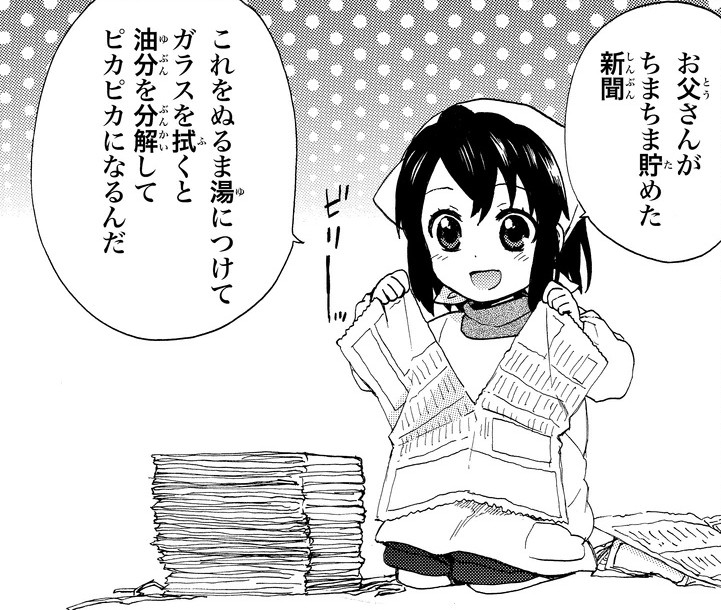
Hinata dedicates the month of December to giving her home a complete cleaning.
- ひなた:
- 「お父さんがちまちま貯めた新聞…」
- “The old newspapers Dad's been saving forever...”
- 「これをぬるま湯につけてガラスを拭くと油分を分解してピカピカになるんだ」
- “Soak them in warm water and wipe the glass, and they cut through the grease and get it sparkling clean.”
- Literal: “If you soak these in lukewarm water and wipe the glass, they break down the oily residue and make it shiny.”
Key Points
1分解 = “break down” into smaller parts
- Here, 油分を分解して means the oily residue gets broken down so it can be wiped away more easily.
- The translation uses “cut through the grease” because that sounds natural in English, but the Japanese image is specifically one of breaking the grease down.
2What を is marking here
- 「油分を分解して」 makes 油分 the thing being acted on, so it is the grease that gets broken down.
3Sentence ending nuance: ピカピカになるんだ
- 「ピカピカになる」 means “become shiny”.
- The んだ ending gives an explanatory tone, like Hinata is sharing a useful cleaning trick she knows.
Vocabulary
油分 (Oil content)
油分 means the oil or fat contained in something. It can also refer to oily residue on a surface.
分解 (Decomposition)
分解 means taking something apart or breaking it down into its components.
See Also
- Kanji: Separating and understanding with 解
- Grammar: Reasoning with 〜のだ
- Future entry: Past tense with 〜た・〜だ
- Grammar: Natural result with 〜と
- Grammar: The copula だ
- Kanji: Dividing and portions with 分
老女的少女ひなたちゃん © its respective creators. It is used here for educational commentary.