Bringing back fish with 釣る
Kanji Explanation: Fishing and baiting with 釣
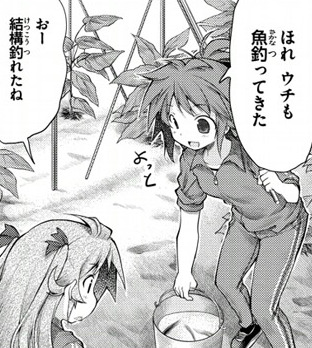
The village kids are having an outdoor cookout at school. Komari and Hotaru have been picking vegetables in the school garden, and Komari is sore that she forgot to bring work gloves. Natsumi walks over and asks if they got any vegetables, and Komari answers that they got a few, more or less.
- 夏海:
- 「ほれ ウチも魚釣ってきた」
- “Here, I went and caught some fish too.”
- 小鞠:
- 「おー 結構釣れたね」
- “Ooh, you caught quite a few.”
Key Points
- 釣る means to catch something with a hook and line. The angler is the subject, and the fish is the object: 魚を釣る. Natsumi drops the を in casual speech.
- Komari answers with 釣れた, from 釣れる. That verb puts the fish first, so 結構釣れたね is closer to “quite a few turned up on your line”.
- 〜てくる after an action means doing it somewhere and then coming back. 釣ってきた is “I went and caught them, and here I am”. The bucket at her feet is the proof.
- ウチ is a first-person pronoun that Natsumi uses for herself. も means “too”: Komari and Hotaru brought vegetables, and Natsumi brought fish.
- ほれ is a casual “here” or “look”, said while showing or handing something over.
- 結構 here means “quite” or “a fair amount”. Komari is mildly impressed.
Vocabulary
| Word | English | Meaning |
|---|---|---|
| ウチ | My home | ウチ is a katakana spelling of うち, “my home”, “my family”, or “our side”. |
| 魚 | Fish | 魚 is a fish. |
| 釣る | To fish | 釣る is to catch a fish with a hook and line. It also means to lure a person with something they want, as in 餌で釣る. |
| くる | To come | くる is to move toward the speaker or the place being talked about. After a て-form verb, it shows a change coming about, or going and coming back. It is the kana spelling of 来る. |
| 結構 | Quite | 結構 as an adverb means “quite” or “fairly”, more than you’d expect. As a な-adjective it means “fine” or “enough”, as in 結構です, “no, thank you”. |
| 釣れる | To be caught | 釣れる says that a fish bites and gets caught. よく釣れる describes a good place or day for fishing, and 釣れない means nothing is biting. |
See Also
- Kanji: Fishing and baiting with 釣
- Grammar: Coming and going with 〜てくる and 〜ていく
- Grammar: Marking the topic with は and も
- Grammar: Seeking agreement with ね
- Kanji: Binding and results with 結