Broken glasses with 眼鏡
Kanji Explanation: Seeing and insight with 眼
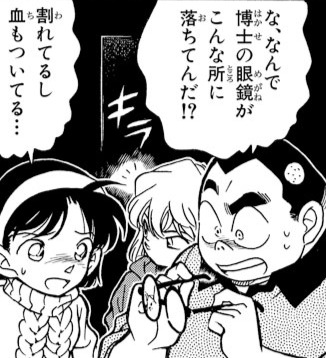
Professor Agasa and the Detective Boys stay overnight in a large villa in the woods after getting lost on a camping trip. Conan and Agasa go missing, leaving the rest of the kids to sneak around at night to search the property for them. After entering a secret passage, Haibana finds spots of blood on the ground, and then Genta finds Agasa’s glasses.
- 元太:
- 「な、なんで博士の眼鏡がこんな所に落ちてんだ!?」
- “W-what the heck? Why are the professor's glasses lying here!?”
- Literal: “W-why are the professor's glasses lying in a place like this!?”
- 歩美:
- 「割れてるし血もついてる…」
- “They're broken and there's blood on them...”
- Literal: “They're broken, and blood is on them too...”
Key Points
1眼鏡 = “eyeglasses”
- In this scene, 眼鏡 simply means the professor’s eyeglasses.
- Even though the kanji are 眼 “eye” and 鏡 “mirror”, 眼鏡 is a fixed everyday word for glasses, not a phrase you normally parse literally in conversation.
2博士の眼鏡がこんな所に = “the professor’s glasses are in a place like this”
- The subject is 博士の眼鏡が “the professor’s glasses”.
- こんな所 means “a place like this”, showing Genta’s shock that they would be lying here in the secret passage.
3落ちてんだ = casual 落ちているんだ
- 「落ちてんだ」 contracts 落ちているんだ in casual speech.
- Here んだ adds an explanatory, alarmed tone: he is not calmly stating a fact, but reacting to surprising evidence in front of him.
4割れてるし血もついてる = piling on bad signs
- 「割れてる」 is casual for 割れている “they’re broken”.
- The し gives one reason/evidence and implies more, while 血も adds “blood too”, making the discovery feel even more ominous.
Vocabulary
博士 (Doctor)
博士 is a title for a learned expert or scientist, often translated as Doctor when attached to a name. The reading はくし refers to a doctoral degree or a person who holds one.
眼鏡 (Glasses)
眼鏡 means glasses or spectacles worn to correct vision, protect the eyes, or as an accessory.
See Also
- Kanji: Seeing and insight with 眼
- Grammar: Marking the topic with は and も
- Grammar: Ongoing actions and resulting states with 〜ている
- Kanji: Reflection and optics with 鏡
名探偵コナン © its respective creators. It is used here for educational commentary.