Brownish and blackish dyes with 〜っぽい
Grammar Explanation: Kind of like with 〜っぽい
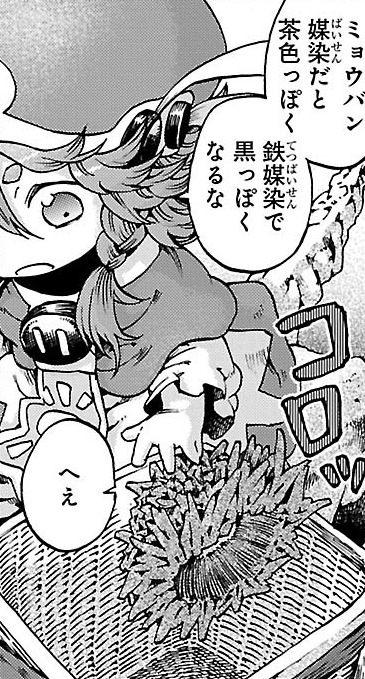
Mikochi is making Sen new clothes and thinks darker colors would suit her, so she sends Hakumei and Sen to gather dye materials such as sawtooth oak. Hakumei shows Sen that sawtooth oak is just acorns. When Sen asks whether acorn caps can really dye cloth, Hakumei says yes. You dye with the shells, caps, and twigs, then finish the cloth in a mordant, a solution that fixes the color.
- ハクメイ:
- 「ミョウバン媒染だと茶色っぽく 鉄媒染で黒っぽくなるな」
- “With an alum mordant, it turns brownish, and with an iron mordant, it turns blackish.”
- セン:
- 「へえ」
- “Huh.”
Key Points
- After a color, っぽい means “-ish”. 茶色っぽい is “brownish” and 黒っぽい is “blackish”.
- Both are い-adjectives, so before なる they take the く form, っぽく, as in 黒っぽくなる, “turns blackish”.
- 茶色っぽく is the く form standing alone, which joins clauses like a て-form. The full idea is 茶色っぽくなって, but the なる comes once, at the end, and covers both colors.
- ミョウバン媒染だと is “with an alum mordant”. だと sets up a condition whose result follows every time, and 鉄媒染で gives the other choice.
Vocabulary
ミョウバン (Alum)
ミョウバン is alum, a mineral salt used to fix dyes in cloth and in cooking and pickling. It is also written 明礬.
媒染 (Mordanting)
媒染 is fixing a dye in cloth with a mordant, a substance such as alum or iron that binds the color to the fibers and changes its shade.
茶色っぽい (Brownish)
茶色っぽい describes a color close to brown, with a brown tint.
鉄媒染 (Iron mordanting)
鉄媒染 is fixing a dye with an iron solution, which darkens the color toward gray or black.
黒っぽい (Blackish)
黒っぽい describes a dark color close to black, such as dark clothes.
っぽい (-ish)
っぽい follows a word to say something seems like it or tends toward it.
なる (To become)
なる is to change into a different state or become something. It also means something turns out a certain way. It is also written 成る.
See Also
- Grammar: Kind of like with 〜っぽい
- Grammar: Becoming with 〜くなる and 〜になる
- Grammar: Natural result with 〜と
- Kanji: Tea and tea culture with 茶