Buying finches instead of waiting with 〜きれずに
Grammar Explanation: Unable to finish with 〜きれない (Future entry)
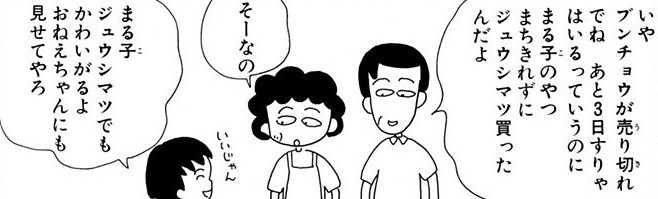
Dad agreed to buy Maruko a Java sparrow chick, and she went with him to the pet shop. They come home with a pair of society finches instead, and Mom asks why they aren’t Java sparrows.
- お父さん:
- 「いや ブンチョウが売り切れでね あと3日すりゃはいるっていうのに まる子のやつまちきれずにジュウシマツ買ったんだよ」
- “Well, the Java sparrows were sold out. They said more would come in three days, but Maruko couldn't wait and bought finches instead.”
- お母さん:
- 「そーなの」
- “Oh, I see.”
- まる子:
- 「いいじゃん」
- “So what?”
- 「まる子ジュウシマツでもかわいがるよ おねえちゃんにも見せてやろ」
- “I'll love them even if they're finches. I'm gonna go show them to my sister too.”
Key Points
- まち is the stem of 待つ, “to wait”, written here in kana. 待ちきれない is “can’t wait”.
- ず is a written or older negative ending, and 〜ずに works like 〜ないで: “without”. まちきれずに is “without being able to wait”.
- This form usually leads into what the person did once the waiting stopped. Here it’s ジュウシマツ買った.
- すりゃ is a casual contraction of すれば. あと3日すれば is “in three more days”.
- って quotes what the shop said, and のに adds Dad’s exasperation: “even though they said…”.
- やつ is a rough word for a person. Dad uses it with a mix of exasperation and affection, like “that kid Maruko”.
- でも after a noun is “even if it’s”. Maruko admits that finches weren’t her first choice.
- 見せてやろ is 見せてやろう with the う dropped. やる makes it something she does for her sister.
Vocabulary
ブンチョウ (Java sparrow)
ブンチョウ is the Java sparrow, a small finch often kept as a pet. It is also written 文鳥.
売り切れ (Sold out)
売り切れ means that something has all been sold and none is left.
あと (After)
あと is the time after something, the space behind something, or what remains. At the start of a sentence, it adds one more point, like “also”. It is also written 後.
する (To do)
する is to do or perform something. It also turns many nouns into verbs, as in 勉強する.
はいる (To enter)
はいる is to go or come inside. It is also used for things arriving, as when a shop gets new stock in. It is also written 入る.
いう (To say)
いう is to put something into words. It is the kana spelling of 言う and appears in phrases like という, which introduces a name or a quoted idea.
やつ (Guy)
やつ is a casual word for a person or thing. It can sound rough or friendly, depending on the speaker. It is also written 奴.
まつ (To wait)
まつ is to stay until someone comes or something happens. まてよ, “wait a minute”, is said when stopping to think. It is also written 待つ.
ジュウシマツ (Society finch)
ジュウシマツ is the society finch, a small, gentle finch often kept as a pet. It is also written 十姉妹.
買う (To buy)
買う is to buy something.
いい (Good)
いい describes something good, nice, or fine. It can also mean “okay” or “that’s enough”. Its other forms come from よい, as in よくない and よかった.
かわいがる (To dote on)
かわいがる is to treat a person or animal with affection and care. It is also written 可愛がる.
おねえちゃん (Big sister)
おねえちゃん is a familiar word for one’s older sister. It is also written お姉ちゃん.
見せる (To show)
見せる is to let someone see something.
やる (To do)
やる is a casual word for “to do”. It also means to give something to someone of lower standing, or to animals and plants.
See Also
- Grammar: Without doing and please don't with 〜ないで
- Grammar: Even though with 〜のに
- Grammar: Quoting and reporting with と and って
- Grammar: Hypothetical condition with 〜ば
- Grammar: Volitional with 〜う・〜よう
- Grammar: How casual contractions work
- Kanji: Seeing and viewpoints with 見