Buying up junk with 買い漁る
Kanji Explanation: Fishing and catches with 漁
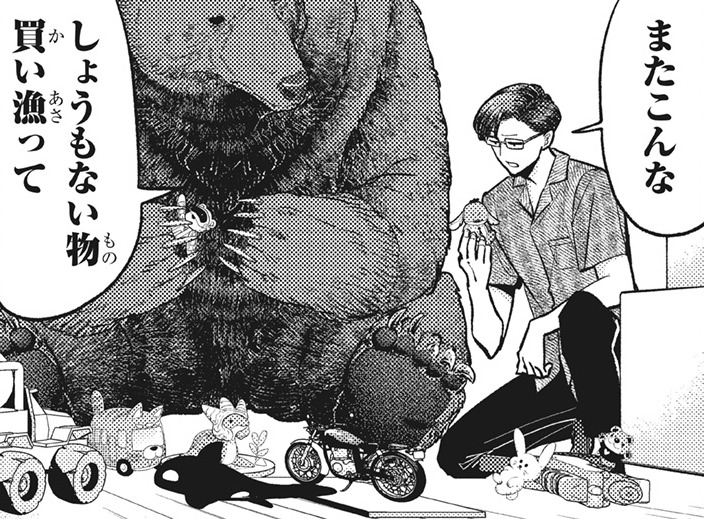
Kumada lives with a bear. When the doorbell rings, the bear hurries to the door in its disguise, carries the delivered boxes into its room, and shuts the door. Kumada peeks in and finds the bear playing among a floor full of new toys and figures.
- 熊田:
- 「またこんなしょうもない物買い漁って」
- “Buying up useless junk like this again...”
Key Points
- The compound joins the stem of 買う, “to buy”, with 漁る, “to search around”. It means going around looking for things and buying them up, one after another.
- The word usually suggests greed or excess. Kumada isn’t describing one purchase but a habit that has filled the room.
- Most words with 漁 are about fishing, such as 漁師 and 大漁. Here 漁る has its other meaning, searching or hunting for something.
- しょうもない means worthless, pointless, or silly. It is a casual word associated with Kansai speech, shortened from しようもない, “there’s nothing to be done about it”.
- Paired with こんな, “this kind of”, it lets Kumada wave at the toys around him and dismiss them all.
- The line ends in the て-form 買い漁って without a following verb. Ending on て like this leaves the sentence open as an exasperated remark, as in “Buying up junk again…”.
- The object particle is dropped: しょうもない物を買い漁って with を is the full form. Casual speech often leaves を out.
- また shows this isn’t the first time.
Vocabulary
| Word | English | Meaning |
|---|---|---|
| また | Again | また means “again” or “once more”. It also means “also”. As a goodbye, またね means “see you”. |
| こんな | Like this | こんな describes something like the thing in front of the speaker or the thing just mentioned. |
| しょうもない | Worthless | しょうもない describes something worthless, pointless, or silly. It is a casual word, especially common in Kansai speech, and comes from しようもない, “nothing can be done about it”. |
| 物 | Thing | 物 is a physical thing or object. |
| 買い漁る | To buy up | 買い漁る is to go around hunting for things and buying them up, one after another. It often suggests buying too much or too eagerly. |
See Also
- Kanji: Fishing and catches with 漁
- Grammar: Connecting actions with 〜て・〜で
- Kanji: Things and kinds with 物