Calling out through a video game with 呼びかける
Vocabulary Explanation: Words ending in 掛ける
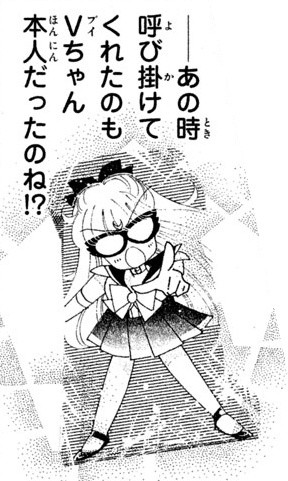
Sailor Venus has just revealed that she is Sailor V, the heroine Usagi idolizes. Venus says she has been in touch with Usagi all along through the arcade’s Sailor V video game, and her cat Artemis adds that the game let Usagi practice fighting. Usagi remembers the time the Sailor V on the game screen spoke to her and urged her into battle.
- うさぎ:
- 「――あの時呼び掛けてくれたのもVちゃん本人だったのね!?」
- “So it was really V-chan herself who called out to me that time, too!?”
Key Points
- 呼ぶ means to call. Adding 掛ける directs the call at someone, so 呼び掛ける means to call out to a person or appeal to them.
- This page writes it with the kanji 掛. You will also see it written 呼びかける.
- 呼び掛けてくれた frames the call as a favor to Usagi. It is the past tense of 〜てくれる.
- の turns あの時呼び掛けてくれた into a noun phrase: “the one who called out to me that time”.
- も means “also”. Usagi has just learned that V-chan taught her to fight through the game, and now she realizes the voice was her too.
- のね confirms what she has just figured out, and !? shows her surprise.
- 本人 means the person in question. Usagi had taken the voice for part of the game. Vちゃん本人 means it was the real Sailor V.
Vocabulary
あの (That)
あの comes before a noun to mean “that” or “those”. It points to someone or something away from both speakers, or something they both know about.
時 (Time)
時 is a point or stretch of time. 〜時 means “when” or “at the time of”.
呼び掛ける (To call out to)
呼び掛ける is to call out to someone to get their attention. It can also mean to appeal to a group, as with a public request. It is also written 呼びかける.
くれる (To give)
くれる is for someone to give something to the speaker or the speaker’s side. After a て-form verb, it means someone does something for the speaker.
See Also
- Vocabulary: Words ending in 掛ける
- Grammar: Receiving kindness with 〜てくれる
- Grammar: Marking the topic with は and も
- Grammar: Seeking agreement with ね
- Kanji: Origins and main things with 本
- Kanji: People and persons with 人
- Kanji: Time and occasions with 時