Came to be studying with us with 〜ことになる
Grammar Explanation: To end up being with 〜ことになる
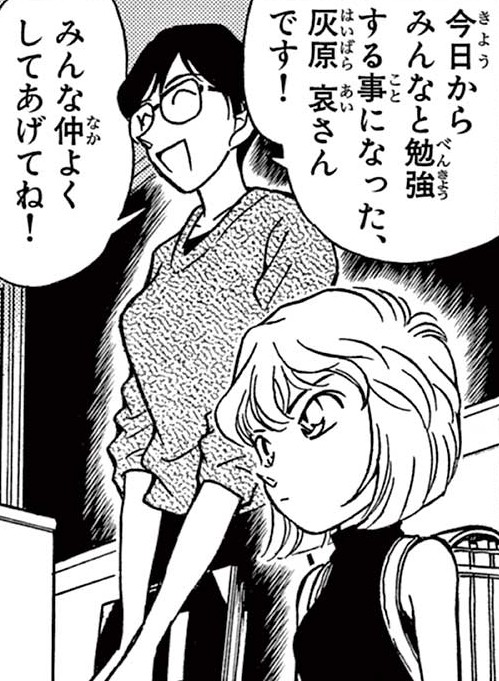
A new student joins Conan’s elementary school classroom. The teacher introduces her.
- 先生:
- 「今日からみんなと勉強する事になった、灰原 哀さんです!」
- “This is Ai Haibara. It came to be that she'll be studying with us starting today.”
- Literal: “This is Ai Haibara, who came to the situation of studying with everyone starting today!”
- 「みんな仲良くしてあげてね!」
- “Everyone be friendly with her!”
Key Points
- Here the teacher is announcing an arranged new situation.
- Ai has not “accidentally ended up” here; the school has determined that she will join the class.
- The full chunk means “to study together with everyone”.
- ことになった wraps that whole action and turns it into the new arrangement.
- 今日から sets the starting point for the new situation.
- The teacher is formally introducing Haibara as a classmate from now on.
- さん is an honorific suffix attached to a person’s name to show respect and social distance, roughly equivalent to “Mr.”, “Ms.”, or “Mrs.” in English, though it’s used far more broadly and doesn’t specify gender or marital status.
Vocabulary
| Word | English | Meaning |
|---|---|---|
| 今日 | Today | 今日 means today. In formal writing, it can also mean the present day or current era. |
| みんな | Everyone | みんな means all the people in a group, or everything. It is also written 皆. |
| 勉強 | Study | 勉強 refers to learning academic subjects or skills, or to devoting oneself wholeheartedly to a task. |
| 事 | Thing | 事 is an abstract thing, matter, or fact. It also turns a verb phrase into a noun, as in 見た事がある. It is often written こと. |
| なる | To become | なる is to change into a different state or become something. It also means something turns out a certain way. It is also written 成る. |
| 仲良く | Getting along | 仲良く describes people getting along well, as friends do. |
| する | To do | する is to do or perform something. It also turns many nouns into verbs, as in 勉強する. |
| あげる | To give | あげる is to give something to someone else. After a て-form verb, it means doing something for someone. It also means to raise something. |
See Also
- Grammar: To end up being with 〜ことになる
- Grammar: Past tense with 〜た・〜だ
- Grammar: Doing for someone with 〜てあげる
- Grammar: Polite style with です and ます
- Grammar: Seeking agreement with ね
- Grammar: Compound voicing with 連濁
- Kanji: Matters and events with 事
- Kanji: Now and the present with 今
- Kanji: Strength and force with 強