Can't die in peace yet with 死んでも死にきれん
Grammar Explanation: Unable to finish with 〜きれない (Future entry)
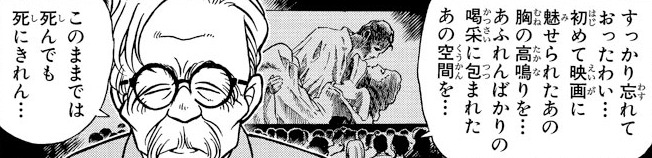
The elderly owner of a small, struggling movie theater had planned to sell it after its final showing. Once a murder there is solved, the Detective Boys tell him how much they love movies, and he runs the monster film Gomera just for them. Watching them cheer at the screen, he decides not to sell after all.
- 館主:
- 「すっかり忘れておったわい… 初めて映画に魅せられたあの胸の高鳴りを… あふれんばかりの喝采に包まれたあの空間を…」
- “I'd forgotten all about it... the way my heart raced the first time a movie captivated me... that whole room wrapped in overflowing applause...”
- 館主:
- 「このままでは死んでも死にきれん…」
- “If it ended like this, I could never die in peace...”
Key Points
- The phrase repeats the verb in the 〜ても〜きれない frame. 死んでも is “even if I died”, and 死にきれない is “I couldn’t finish dying”, meaning he couldn’t truly be at rest.
- It’s a set phrase for a regret strong enough to keep you from resting in peace. Something important would still be left undone.
- きれん is きれない with the older negative ん. It suits the speech of an elderly man.
- このまま is “the way things are”, and では makes it a condition with a bad outcome. Here, it means selling the theater without seeing it full again.
- 忘れておった uses おる where most speakers would say いる: 忘れていた, “I had forgotten”. わい at the end is an old-fashioned sentence ending.
- 〜んばかり means “as if about to”. あふれんばかり is “as if about to overflow”. It describes how loud the applause used to be.
Vocabulary
すっかり (Completely)
すっかり describes a change that has gone all the way, so that nothing of the earlier state is left, as in すっかり忘れる, “forget entirely”.
忘れる (To forget)
忘れる is to forget something. It also means to leave something behind by mistake.
おる (To be)
おる is a humble or polite form of いる. In western Japanese dialects, it is the everyday word for いる, and after a て-form verb it shows an ongoing action.
初めて (For the first time)
初めて describes doing something for the first time.
映画 (Film)
映画 is a movie, a story told in moving pictures shown on a screen.
魅せる (To captivate)
魅せる is to captivate or enchant someone. 魅せられる is to be captivated by something.
あの (That)
あの comes before a noun to mean “that” or “those”. It points to someone or something away from both speakers, or something they both know about.
胸 (Chest)
胸 is the chest. It also stands for the heart and one’s feelings, as in 胸の高鳴り, a heart pounding with excitement.
高鳴り (Pounding)
高鳴り is a loud ringing or pounding, especially of the heart when someone is excited.
あふれる (To overflow)
あふれる is to spill over because something is too full. It also describes crowds, or feelings that can’t be contained. It is also written 溢れる.
包む (To wrap)
包む is to wrap something up or cover it completely. It is also used for a sound or atmosphere that surrounds someone.
このまま (As is)
このまま means “the way things are now”. このままでは is “if things go on like this”, usually warning of a bad result.
死ぬ (To die)
死ぬ is to die. In casual speech, 死んじゃう exaggerates a hardship: “it’ll kill me”.
See Also
- Grammar: Even if with 〜ても
- Grammar: As if with 〜んばかり
- Grammar: Negation with 〜ない
- Kanji: Death and dying with 死
- Kanji: Pictures and plans with 画
- Kanji: Spaces and intervals with 間