Can't give up on Tanabata with あきらめきれない
Grammar Explanation: Unable to finish with 〜きれない (Future entry)
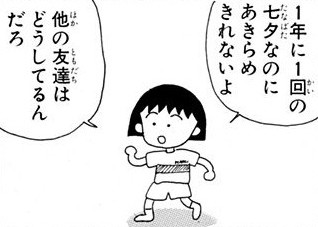
It’s the day before Tanabata, and Maruko needs a bamboo branch to hang her wishes on. Dad brought one home by chance last year but won’t find one this time, so she throws a tantrum. Mom tells her it makes no difference whether she has bamboo, and Dad says sometimes you can’t get what you want.
- まる子:
- 「1年に1回の七夕なのにあきらめきれないよ」
- “Tanabata only comes once a year. I can't just give up on it!”
- 「他の友達はどうしてるんだろ」
- “I wonder what my other friends are doing.”
Key Points
1あきらめきれない, “I can’t give up on it”
- あきらめ is the stem of 諦める, “to give up on”. 〜きれない says Maruko can’t bring herself to let go of it completely.
- With feelings like this, nothing bursts out. The wish just stays, however much she’s told to drop it.
21年に1回の七夕なのに
- 1年に1回 is “once a year”. に gives the period the count applies to.
- のに after a noun takes な: 七夕なのに. It shows frustration: it’s a once-a-year event, and yet she’s supposed to go without.
3どうしてるんだろ, “I wonder what they’re doing”
- どうしてる is the casual contraction of どうしている. んだろ is んだろう with the う dropped, a way of wondering out loud.
Vocabulary
あきらめる (To give up)
あきらめる is to give up on a hope or plan and accept that it won’t happen. It is also written 諦める.
他 (Other)
他 means another person, thing, or place, other than the one mentioned.
友達 (Friend)
友達 means a friend or companion. Despite the suffix 達, it can refer to either one friend or several friends.
See Also
- Grammar: Even though with 〜のに
- Grammar: Presuming with 〜だろう and 〜でしょう
- Grammar: How casual contractions work
- Kanji: Reaching and attaining with 達
ちびまる子ちゃん © its respective creators. It is used here for educational commentary.