Can't let you push yourself with 〜させられない
Grammar Explanation: Being made to do with 〜させられる
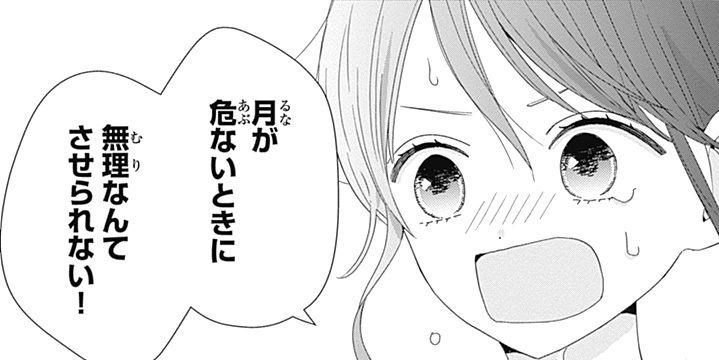
Ayumu and Luna end up hiding in a hot spring bath while two other boys soak nearby, and Luna overheats waiting for them to leave. When the boys finally go, Luna is too dizzy to walk, but he won’t let Ayumu go out first to get help, because then someone would see her. Seeing him suffer for her sake, Ayumu stands up.
- 歩:
- 「月が危ないときに無理なんてさせられない!」
- “You're in trouble, Luna! I can't let you push yourself like this!”
- Literal: “When Luna is in danger, I can't make him do something unreasonable!”
Key Points
- させる plus the potential られる gives させられる, “can make someone do”. It’s spelled the same as the causative-receptive, “be made to do”.
- To tell them apart, ask who’s making it happen. Here it’s Ayumu, the speaker, who would be making Luna push himself, so it’s the potential: “I can’t make you”.
- If it were the causative-receptive, Ayumu would be the one forced to push herself. That doesn’t fit, since Luna is the one in trouble.
- 無理 is something unreasonable or beyond your limits. 無理をする is “overdo it” or “push yourself”, and 無理をさせる is “make someone overdo it”.
- Luna has been toughing out the heat so that nobody sees Ayumu. Ayumu won’t let that go on.
- なんて takes the place of を and treats 無理 as something out of the question: “pushing yourself? No way”.
- ときに is “at a time when”. 月が危ないときに is “when you’re in danger”, and it gives the reason she can’t let things go on.
- Ayumu uses Luna’s name where English would say “you”.
Vocabulary
危ない (Dangerous)
危ない describes something dangerous or risky. Said alone, it is a warning: “look out!”
とき (Time)
とき is a point or stretch of time. After a clause, it means “when” or “at a time when”. It is also written 時.
無理 (Impossible)
無理 means impossible, unreasonable, or too demanding. In conversation, it can mean “that’s impossible” or warn someone not to push too hard.
なんて (Such a thing as)
なんて follows a word to treat it lightly or with surprise: “things like” or “such a thing as”. At the start of a phrase, it means “what a…!”
させる (To make someone do)
させる is the causative form of する. It means to make someone do something or to let them do it.
See Also
- Grammar: Being made to do with 〜させられる
- Grammar: Able to do with 〜れる・〜られる
- Grammar: Making and letting with 〜せる・〜させる
- Kanji: Absence and nothingness with 無