Can't rule out ulterior motives with 言い切れない
Grammar Explanation: Unable to finish with 〜きれない (Future entry)
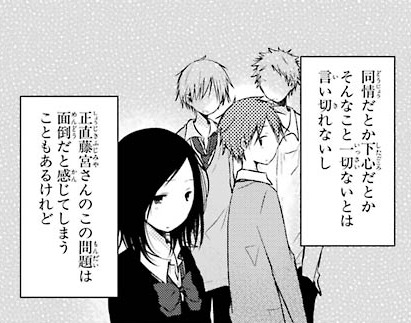
Fujimiya forgets her friends every week, so Hase asks her to be his friend again each Monday. On Friday after school, she tells him that her diary records the same line every Monday, “Please be my friend again.” She asks whether she can look forward to hearing it next week, and he says of course.
- 長谷:
- 「同情だとか下心だとか そんなこと一切ないとは言い切れないし」
- “Pity, ulterior motives... I can't say for sure there's none of that at all...”
- 「正直藤宮さんのこの問題は面倒だと感じてしまうこともあるけれど」
- “...and honestly, sometimes I can't help feeling that Fujimiya's problem is a hassle, but...”
Key Points
- 言い切る means “to state flatly” or “declare”. Here 切る is about saying something decisively, not finishing it. 言い切れない is “can’t say for sure”.
- とは quotes the claim he can’t make: 一切ない, “there’s none at all”. Hase doesn’t say he has ulterior motives. He only says he can’t rule them out.
- 一切 with a negative means “not at all”, which makes the claim too strong for him to stand behind.
- 〜だとか〜だとか lists examples loosely, “things like”. そんなこと then sums them up as “that sort of thing”.
- し lists one reason and leaves room for another. The second box adds a second admission and ends in けれど, “but”, which sets up the reason he keeps going anyway.
- 〜てしまう shows he doesn’t want to feel this way. The feeling comes anyway.
Vocabulary
下心 (Ulterior motive)
下心 is a hidden intention behind what someone does, usually a selfish one.
そんな (Like that)
そんな describes something like the thing just mentioned. Said alone, it shows shock or denial: “no way!”
こと (Thing)
こと is an abstract thing, matter, or fact, as opposed to a physical object. It also turns a verb phrase into a noun, as in 見たことがある. It is also written 事.
言い切る (To state flatly)
言い切る is to say something definitively, without hedging. 言い切れない means “can’t say for sure”.
この (This)
この means “this” or “these” and comes directly before a noun. It points to something near the speaker or something the speaker is referring to in the conversation.
面倒 (Trouble)
面倒 means trouble, bother, or something difficult to deal with. It can also mean caring for someone or something.
感じる (To feel)
感じる is to feel something through the senses or emotions.
See Also
- Grammar: Doing completely or ending up doing with 〜てしまう and 〜ちゃう
- Grammar: But with 〜けど and 〜けれど
- Grammar: Quoting and reporting with と and って
- Grammar: Marking the topic with は and も
- Kanji: Below and lowering with 下
- Kanji: Faces and surfaces with 面
- Kanji: Topics and assigned problems with 題