Care for not only Lou's face but also her body with 〜だけでなく〜も
Grammar Explanation: Not only this but also that with 〜だけではなく〜も
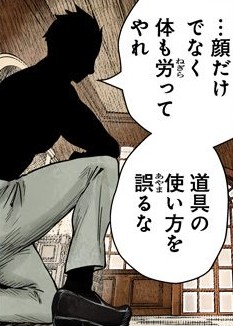
Benjamin suggests Louise do push-ups alongside Lou, her “Living Doll”. When Louise tires quickly, Benjamin tells her to care for Lou’s body as well as her face.
- ベンジャミン:
- 「顔だけでなく体も労ってやれ。」
- “Take care of not only her face but also her body.”
- Literal: “Give care not only to her face but also to her body.”
- 「道具の使い方を誤るな」
- “Don't misuse your tools.”
- Literal: “Do not mistake how to use your tools.”
Key Points
- 顔だけでなく体も sets up “not only the face, but the body too”.
- The second も marks the added item, so the care should extend beyond Lou’s face.
- 労う means to appreciate or take care of someone after effort; here it fits Benjamin’s advice after push-ups.
- 〜てやれ is a rough supportive command: “do it for them”.
- 道具の使い方を誤るな frames the body as a tool that should not be misused.
Vocabulary
顔 (Face)
顔 is the face. It also means one’s expression or reputation.
体 (Body)
体 means the body or physique of a person or animal. It can also refer to physical health or condition.
労う (To show appreciation)
労う is to thank someone for their hard work and show care for them.
やる (To do)
やる is a casual word for “to do”. It also means to give something to someone of lower standing, or to animals and plants.
道具 (Tool)
道具 is a thing you use to do a job, from a hammer to a paintbrush. A person treated as a means to an end is also called a 道具.
使い方 (How to use)
使い方 is how you operate or apply something. It also covers how a thing gets spent, as in お金の使い方.
誤る (To make a mistake)
誤る is to do something wrongly or misuse something.
See Also
- Grammar: Not only this but also that with 〜だけではなく〜も
- Grammar: The plain imperative
- Grammar: Marking the topic with は and も
- Grammar: Doing for someone with 〜てあげる
- Kanji: Body and substance with 体