Catching a big boar with 獲れる
Vocabulary Explanation: Taking, catching, and photographing with とる
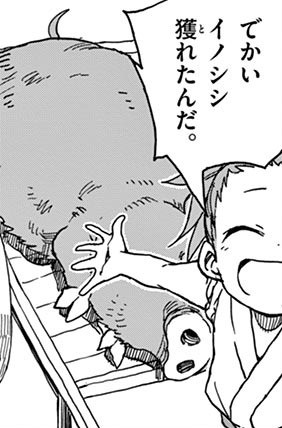
Sazanka has slipped out of class to go see Tsubaki, and Asagao has been told she gets no dinner unless she brings Sazanka back. Asagao chases her across the rooftops. Sazanka tries to buy her off with more dried sweet potatoes than dinner would give her, and Asagao asks for time to think it over. Below them, Higuruma cups a hand to her mouth and calls up to them, telling them to listen and rejoice. Then she builds up to her news.
- ヒグルマ:
- 「でかいイノシシ獲れたんだ。」
- “A huge wild boar got caught!”
Key Points
1獲れた = “got caught”, said of game
- Here 獲れる means a catch came in. The boar is the thing caught, so it’s the subject. Who hunted it never comes up. English could also say “We caught a huge wild boar!”, but Japanese doesn’t need to name anyone.
- Compare 獲る, the transitive verb. イノシシを獲った would be “we caught a boar”, focused on the hunters. イノシシが獲れた is “a boar got caught”, focused on the result. Japanese uses this intransitive とれる for anything you bring in from nature, such as fish, crops, or game.
- The same form also works as a potential, “be able to catch”. Here the た and the boar lying right there make it the plain “got caught”. Read as a potential, it would mean the hunters finally managed it.
2Why 獲 and not the default 取
- 取 would be fine here. The writer chose 獲 because the boar is game, the 獲 of 獲物, “prey”. デジタル大辞泉 lists 獲る as another way to write とる for catching animals.
- The 常用漢字表 gives 獲 no とる reading, but manga use 獲 for hunting and fishing anyway. 捕 is the official choice for catching something that moves, but it puts the weight on the capture. 獲 puts it on the haul.
3Announcing news with んだ
- んだ is the casual form of のだ. After 獲れた, it presents the catch as the news behind all her shouting, the reason she called everyone over.
Vocabulary
| Word | English | Meaning |
|---|---|---|
| でかい | Big | でかい is a casual, rough word for “big”. |
| イノシシ | Wild boar | イノシシ is a wild boar, a wild pig hunted for its meat in Japan. It is also written 猪. |
| 獲れる | To be caught | 獲れる is for fish or game to be caught. It also means being able to catch it, or being able to win a prize. |
See Also
- Vocabulary: Taking, catching, and photographing with とる
- Future entry: Transitivity in Japanese
- Grammar: Reasoning with 〜のだ
くノ一ツバキの胸の内 © its respective creators. It is used here for educational commentary.