Catching char with 獲れる
Vocabulary Explanation: Taking, catching, and photographing with とる
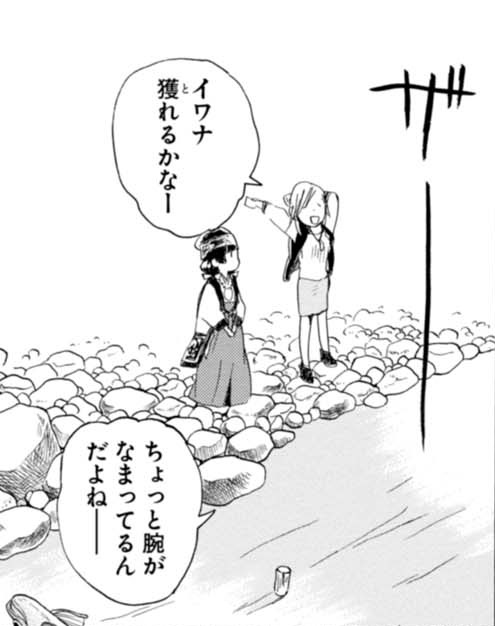
Machi wants to learn to chat with Hibiki, so she practices on Natsu, calling him ひびきちゃん. The talk keeps stalling. When Natsu comes back from the bathroom, Machi sees him as Hibiki, and the conversation suddenly flows. “Hibiki” suggests they get something to eat and leads Machi off to the river.
- ナツ:
- 「イワナ獲れるかなー」
- “Wonder if I can catch some char!”
- 「ちょっと腕がなまってるんだよねー」
- “I'm a little out of practice, though.”
Key Points
- 獲れる comes from 獲る, “catch” or “hunt”. Like any る-ending godan verb, it makes its potential by changing る to れる, so 獲れる is “can catch”. “Hibiki” is wondering if she’ll be able to land some char.
- The same とれる is also the intransitive verb “be caught”. 魚が獲れる often means “the fish are biting” or “you get fish here”, with no catcher in view. The two readings overlap a lot. Here the next line, about her own skill getting rusty, tips it toward “can I catch”.
- Speech drops the particle after イワナ. With the potential, it could be が or を. Either way, イワナ is the fish she hopes to catch.
- The default spelling is 取, and 取れる would be fine here. 捕 also fits catching fish. The writer picked 獲, the kanji of 獲物, “prey”, which makes the char sound like game hunted for food.
- The 常用漢字表 gives 獲 no とる reading, so this is a manga spelling, not an official one. Manga reach for it often for a catch from the wild, and it suits someone about to wade in and grab fish by hand.
- かな after a plain verb is “I wonder”. It’s half a question to herself and half an invitation for Machi to wonder along. The stretched ー keeps it cheerful.
- 腕 is “arm”, and also your skill at something. 腕がなまる is for that skill to get rusty from lack of use. なまってる is the casual form of なまっている, the state of having gone rusty.
- んだよね explains her situation and looks for a nod from Machi: “I’m out of practice, you know.” The ー stretches it out like a sigh.
Vocabulary
| Word | English | Meaning |
|---|---|---|
| イワナ | Char | イワナ is the Japanese char, a trout-like fish of cold mountain streams, often caught and grilled on a skewer. It is also written 岩魚. |
| 獲れる | To be caught | 獲れる is for fish or game to be caught. It also means being able to catch it, or being able to win a prize. |
| ちょっと | A little | ちょっと describes a small amount or a short time. It also softens a refusal, or calls someone’s attention, like “hey”. |
| 腕 | Arm; skill | 腕 is the arm, especially from the shoulder to the wrist. It also means skill at something, as in 腕がいい, “skilled”, and 腕を磨く, “hone your skills”. |
| なまる | To get rusty | なまる is for a skill or the body to get rusty or dull from lack of use, as in 腕がなまる. It is also written 鈍る. A different なまる, 訛る, means to speak with an accent. |
See Also
- Vocabulary: Taking, catching, and photographing with とる
- Grammar: Able to do with 〜れる・〜られる
- Grammar: Wondering with かな
- Grammar: Ongoing actions and resulting states with 〜ている
- Grammar: Reasoning with 〜のだ