Catching our food by the sea with 獲る
Vocabulary Explanation: Taking, catching, and photographing with とる
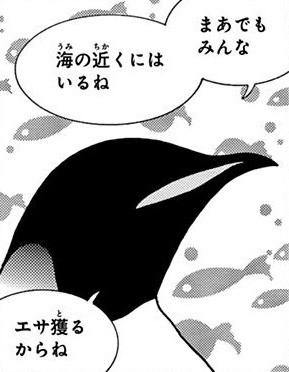
At the café, Panda is looking over picture cards of different penguin species with Penguin. He has just learned that Fiordland penguins live in forests, Humboldt penguins on sandy ground, and yellow-eyed penguins in grassland, and says his picture of penguins is starting to change.
- ペンギンさん:
- 「まあでも みんな海の近くにはいるね」
- “Well, we all live near the sea, though.”
- 「エサ獲るからね」
- “That's where we catch our food.”
Key Points
- 獲る is catching an animal or fish, usually for food. Penguin uses it for the fish penguins catch in the sea.
- The default spelling 取る would still be readable, and 捕る also fits a catch. The writer chose 獲, the kanji of 獲物, “prey”, because the point is hunting for food.
- 獲る is not on the official list of readings, which gives 獲 only える, so careful writing would use 取る or 捕る here. Manga use 獲る freely. A few pages later Penguin talks about walking from inland nesting grounds to the sea to 餌を獲りにいく, “go catch food”.
- から gives a reason. Penguin states the result first, みんな海の近くにはいる, then adds the reason as its own sentence and stops on から.
- ね makes the reason sound like something Panda should agree with once he hears it. “That’s where we catch our food, after all.”
- In casual speech the object marker を often drops out, so エサ獲る is エサを獲る.
- まあでも grants what Panda said, that penguins live in surprising places, before adding a point that still holds.
- は after に sets up a contrast. 海の近くにはいる is “they live near the sea, at least”, whatever the land around them looks like.
Vocabulary
| Word | English | Meaning |
|---|---|---|
| まあ | Well | まあ is a soft “well” that eases into what the speaker says, or accepts something half-heartedly. It also shows mild surprise, like “oh my”. |
| みんな | Everyone | みんな means all the people in a group, or everything. It is also written 皆. |
| 海 | Sea | 海 is the sea or ocean, the large body of salt water that covers much of the earth. |
| 近く | Nearby | 近く is the area close to a place. この近くに means “around here”. |
| いる | To be | いる is to exist or be somewhere, for people and animals. After a て-form verb, it shows an ongoing action or a continuing state. |
| エサ | Bait | エサ is food given to animals or put on a hook to catch fish. It is the katakana spelling of 餌. |
| 獲る | To catch; to hunt | 獲る is to catch an animal or fish, or to hunt game. It is also used for winning a prize or title. |
See Also
- Vocabulary: Taking, catching, and photographing with とる
- Grammar: Because with 〜から
- Grammar: Seeking agreement with ね
- Grammar: Marking the topic with は and も