Checking on a drunk angler with 渓流釣り
Kanji Explanation: Fishing and baiting with 釣
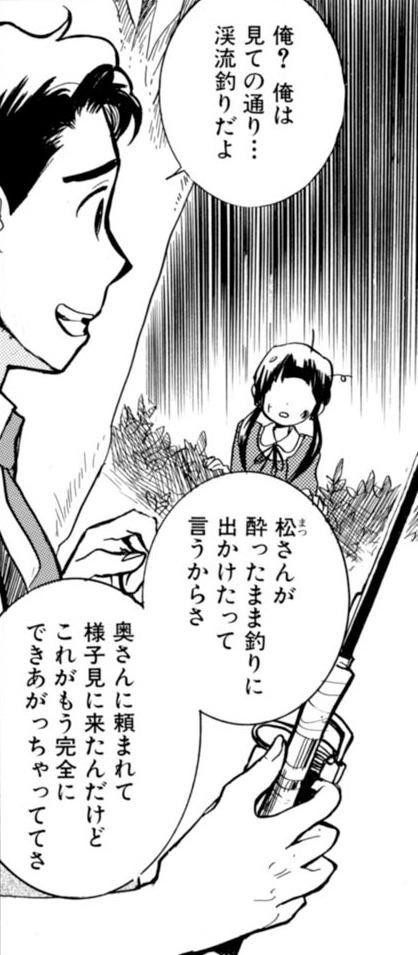
Machi sets out for the Uniqlo in town on an errand, but the heavy bicycle she borrowed falls apart on the mountain road. She decides to cut straight across the mountain on foot and climbs down a steep slope to a stream, where she runs into Yoshio holding a fishing rod. He asks what she’s doing on such a steep slope.
- 良夫:
- 「俺? 俺は見ての通り…渓流釣りだよ」
- “Me? Well, as you can see... I'm stream fishing.”
- 「松さんが酔ったまま釣りに出かけたって言うからさ」
- “I heard Matsu went off fishing while he was still drunk.”
- 「奥さんに頼まれて様子見に来たんだけど これがもう完全にできあがっちゃっててさ」
- “His wife asked me to come check on him, but he's totally plastered.”
Key Points
- 渓流 is a stream flowing through a mountain valley: 渓 is a valley and 流 is a current. 渓流釣り is fishing in such a stream.
- The つ of 釣り changes to づ after another word, as in 海釣り and 川釣り.
- 見ての通り means “as you can see”. 通り after a verb means “just as”. Yoshio says it because he’s obviously holding a fishing rod.
- って quotes what he heard, and 言うから gives it as the reason. 酔ったまま釣りに出かけたって言うから is “since I heard Matsu went fishing while drunk”.
- さ at the end makes it chatty and relaxed, like “see” or “you know”.
- 様子見に来た is “came to check on him”. The verb stem plus に来る gives the purpose of coming.
- できあがる usually means “to be finished”. In casual speech it can also mean someone is thoroughly drunk. ちゃって adds that it went too far, and てて is the casual ていて.
Vocabulary
| Word | English | Meaning |
|---|---|---|
| 俺 | I | 俺 means “I” or “me”. Men commonly use it in casual speech, and it sounds rougher and more masculine than 私 or 僕. |
| 見る | To see | 見る is to see, look at, or watch something. It also means to check or judge something, or to look after someone, as in 面倒を見る. |
| 通り | As | 通り follows a word to mean “in the same way as”: 今まで通り, “as before”. It also means a street. |
| 渓流釣り | Stream fishing | 渓流釣り is fishing in a mountain stream, often for trout and other freshwater fish. |
| 酔う | To get drunk | 酔う is to get drunk. It also means to feel sick from motion, or to be carried away by something. |
| まま | As is | まま describes something left in the same state, without change: “as it is” or “while still…”. |
| 釣り | Fishing | 釣り is fishing with a rod, line, and hook. In a shop, 釣り, often お釣り, is also the change you get back after paying. |
| 出かける | To go out | 出かける is to leave home to go somewhere. |
| 言う | To say | 言う means to say or tell. It can also mean to call something by a particular name. |
| 奥さん | Wife | 奥さん is a polite word for someone else’s wife, or a way to address a married woman. |
| 頼む | To ask | 頼む is to ask someone to do something, or to order something. |
| 様子 | State | 様子 is how someone or something looks, seems, or is doing. It can describe a person’s condition, the mood of a place, or the state of a situation. |
| 来る | To come | 来る means to come or move toward the speaker or the place being discussed. |
| これ | This | これ points to something close to the speaker, or to the thing just mentioned. |
| もう | Already | もう means something has already happened, or with a negative, “no longer”. Before a number, it means “more”. Said alone, it shows frustration. |
| 完全 | Complete | 完全 means complete or perfect, with nothing missing or deficient. |
| できあがる | To be finished | できあがる means something is finished or ready. In casual speech it also means someone is thoroughly drunk. |
See Also
- Kanji: Fishing and baiting with 釣
- Grammar: Quoting and reporting with と and って
- Grammar: Coming to for a purpose with 〜に来る
- Grammar: Doing completely or ending up doing with 〜てしまう and 〜ちゃう
- Grammar: Casual emphasis with さ
- Kanji: Childhood and small things with 子
- Kanji: Forms and appearances with 様
- Kanji: Going out and emerging with 出
- Kanji: Seeing and viewpoints with 見
- Kanji: Wholeness and completion with 全