Chocolate straight over the flame with 火にかける
Vocabulary Explanation: Collocations for cooking
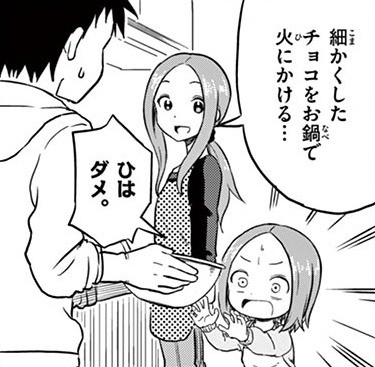
On Valentine’s Day, Chii wants to bake a chocolate cake, and she talks her dad into helping. Takagi announces that the first step is melting the chocolate, and Chii says she wants to do it.
- 高木:
- 「細かくしたチョコをお鍋で火にかける...」
- “You put the chopped chocolate in a pot and set it over the heat...”
- ちー:
- 「ひはダメ。」
- “No fire!”
Key Points
- かける means to set something on or over something else. に marks the fire as where the pot goes, so 火にかける is “put it over the flame”.
- The thing being heated takes を: 鍋を火にかける, “put the pot on the stove”. Here を marks the chocolate, and で marks the pot it’s heated in.
- The opposite is 火から下ろす, “take off the heat”. Turning off the burner is 火を止める.
- 細かい means small or fine. An い-adjective’s く form plus する means to make something that way, so 細かくする is “make it small”, or chop it up.
- The past form 細かくした modifies チョコ: “the chocolate you’ve chopped up”.
Vocabulary
細かい (Small)
細かい describes something small or fine. It also describes attention to small details.
する (To do)
する is to do or perform something. It also turns many nouns into verbs, as in 勉強する.
チョコ (Chocolate)
チョコ is short for チョコレート, chocolate.
お鍋 (Pot)
お鍋 is a cooking pot or saucepan. The お makes the word sound softer and more polite, as in everyday kitchen talk.
火 (Fire)
火 is fire or flame. In cooking, it also means the heat of a stove, as in 火を通す, “to cook something through”.
かける (To hang)
かける is to hang something up or put it over something else. It also means to spend time or money, to cause someone trouble, to make a phone call, and more. It is also written 掛ける.
ダメ (No good)
ダメ is a katakana spelling of だめ, describing something that is useless or not allowed.
See Also
- Vocabulary: Collocations for cooking
- Grammar: Marking the direct object with を
- Grammar: Marking the topic with は and も