Cold hands on the cheeks with 〜たばかりの頃
Grammar Explanation: Just happened with 〜た+ばかり
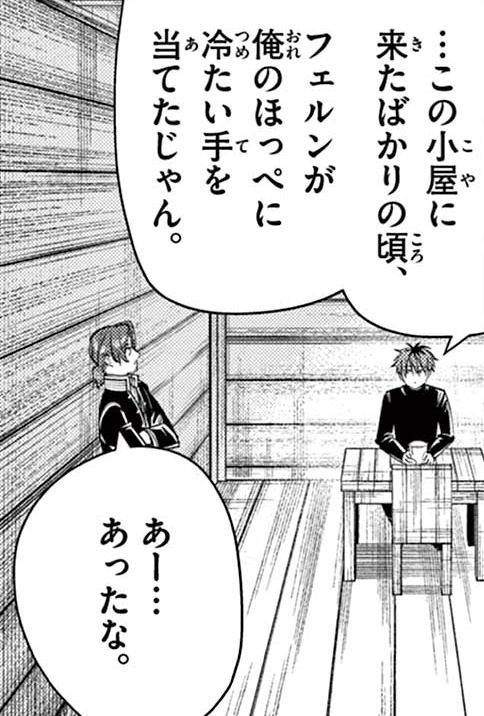
The party is waiting out a cold wave in a northern village, staying in a rented cabin. As the cold wave nears its end, Frieren asks Sein to make peace between Stark and Fern, who seem to be fighting. Fern blames Stark, and Stark says it’s all his fault, so Sein takes Stark into the next room by himself and asks what happened.
- シュタルク:
- 「…この小屋に来たばかりの頃、フェルンが俺のほっぺに冷たい手を当てたじゃん。」
- “…Back when we'd just come to this cabin, Fern put her cold hands on my cheeks, remember?”
- ザイン:
- 「あー…あったな。」
- “Ah… Yeah, that happened.”
Key Points
- The た-form 来た plus ばかり says the arrival had only just happened.
- の links that clause to 頃, “time” or “days”. Together they set a time in the past: the first days at the cabin.
- The arrival is recent only as seen from back then. The party has spent most of the cold wave in the cabin since.
- 手を当てる means to put a hand against something. Here it’s Stark’s cheeks.
- じゃん asks Sein to agree. Sein was in the room that day, so Stark reminds him of it rather than telling him something new.
- ほっぺ is a casual, childlike word for 頬, “cheek”.
- あった is the past of ある. For an event, it means “that happened”.
- あー and な show Sein recalling it as he speaks: “Ah, yeah, that did happen.”
Vocabulary
この (This)
この means “this” or “these” and comes directly before a noun. It points to something near the speaker or something the speaker is referring to in the conversation.
小屋 (Hut)
小屋 means a small, simple building such as a hut, shed, or animal shelter.
来る (To come)
来る means to come or move toward the speaker or the place being discussed.
頃 (Time, days)
頃 is a period or point in time, as in 子どもの頃, “when I was a child”. After a time expression it is read ごろ and means “around”, as in 三時頃.
俺 (I)
俺 means “I” or “me”. Men commonly use it in casual speech, and it sounds rougher and more masculine than 私 or 僕.
ほっぺ (Cheek)
ほっぺ is a casual, childlike word for the cheek. It is short for ほっぺた. The standard word is 頬.
冷たい (Cold)
冷たい describes something cold to the touch, such as hands, water, or a drink. For cold weather, 寒い is used instead. It also describes a person who is cold or unfriendly.
手 (Hand)
手 is a hand. It also means a way or means, or help from someone.
当てる (To hit a target)
当てる is to make something hit or touch a target, such as striking someone with a ball or holding a hand to a forehead. It also means to guess correctly, to win a prize, or to call on someone in class.
ある (To exist)
ある is to exist or be in a place, for things and plants rather than people or animals. It also means to have something, or for an event to take place.
See Also
- Grammar: Just happened with 〜た+ばかり
- Grammar: The copula だ
- Grammar: Past tense with 〜た・〜だ
- Kanji: Hands and skill with 手
- Kanji: Matching and appropriateness with 当
- Kanji: Shelter and shops with 屋