Coming all the way out here with 足を運ぶ
Idiom Explanation: Going out of your way to do something with 足を運ぶ
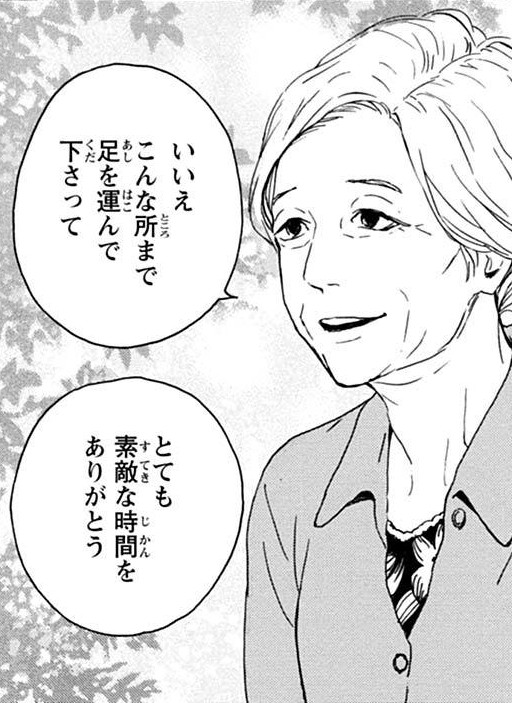
As Suwa and his friends leave Kakeru’s grandmother’s house, Suwa apologizes for the bother.
- おばあさん:
- 「いいえ こんな所まで足を運んで下さってとても素敵な時間をありがとう」
- “No, thank you very much for coming all the way here and having such a wonderful time.”
- Literal: “No, thank you for carrying your feet all the way to a place like this and giving me such a wonderful time.”
Key Points
- Literally it is “to carry one’s feet”, but in real usage it means going somewhere deliberately.
- Here it conveys gratitude that they took the trouble to come all the way to her place.
- 「こんな所まで」 means “all the way to a place like this”.
- 「足を運んで下さって」 is a polite, grateful way to say “for coming”.
- 下さって is the て-form of 下さる, the respectful verb for someone doing something for you. It is not a request like 〜て下さい.
- The grandmother is respectfully describing the visitors’ action and thanking them for it.
- The sentence joins two reasons for gratitude: they came all the way there, and they shared a wonderful time.
- That is why the line ends with ありがとう, covering both parts at once.
Vocabulary
こんな (Like this)
こんな describes something like the thing in front of the speaker or the thing just mentioned.
所 (Place)
所 is a place or spot. It also refers to a point in time or an aspect of something.
足を運ぶ (To make the trip)
足を運ぶ is to take the trouble of going somewhere in person.
下さる (To kindly give)
下さる is a respectful verb for someone giving you something. After a verb’s て-form, it means someone kindly does that action for you.
とても (Very)
とても describes a high degree. With a negative, it means “not at all” or “can’t possibly”.
素敵 (Lovely)
素敵 describes something that delights the speaker, such as a dress, a person, or an idea. Manga also print it ステキ.
時間 (Time)
時間 is time, or an amount of time. It also means an hour, or a set time for something.
See Also
- Idiom: Going out of your way to do something with 足を運ぶ
- Grammar: Receiving kindness with 〜てくれる
- Grammar: Until an action occurs with 〜まで
- Grammar: Marking the direct object with を
- Kanji: Below and lowering with 下
- Kanji: Spaces and intervals with 間
- Kanji: Time and occasions with 時