Coming to visit with 〜に来る
Grammar Explanation: Coming to for a purpose with 〜に来る
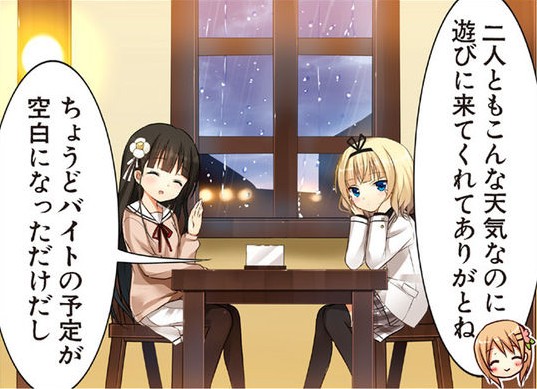
Chiya and Syaro visit Cocoa at the coffee shop.
- ココア:
- 「二人ともこんな天気なのに遊びに来てくれてありがとね」
- “Thanks, both of you, for coming to visit even in weather like this.”
- Literal: “Thanks for coming for playing, both of you, even in weather like this.”
- シャロ:
- 「ちょうどバイトの予定が空白になっただけだし」
- “I just happened to have a gap in my work schedule.”
Key Points
- The set expression uses “come to play” for a social visit, so “visit” fits the scene.
- 遊ぶ becomes 遊び, followed by purpose marker に and 来る.
- Cocoa treats their visit as something done for her benefit. こんな天気なのに stresses that they came despite the bad weather.
- Syaro says her work schedule merely happened to become free. Final し leaves the excuse open instead of making a warm admission.
Vocabulary
| Word | English | Meaning |
|---|---|---|
| 二人とも | Both | 二人とも takes a pair of people and says something is true of each of them. |
| こんな | Like this | こんな describes something like the thing in front of the speaker or the thing just mentioned. |
| 天気 | Weather | 天気 means weather, such as whether it is sunny, cloudy, or rainy. |
| 遊ぶ | To play | 遊ぶ is to play or have fun. 遊びに来る means to come over to visit. |
| 来る | To come | 来る means to come or move toward the speaker or the place being discussed. |
| ちょうど | Just | ちょうど describes something that fits exactly, or happens at just the right time. |
| バイト | Part-time job | バイト is short for アルバイト, a part-time job. |
| 予定 | Schedule | 予定 is something planned ahead of time, such as an appointment, a trip, or an event. |
| 空白 | Blank | 空白 is an empty space or a blank period with nothing in it. |
| なる | To become | なる is to change into a different state or become something. It also means something turns out a certain way. It is also written 成る. |
See Also
- Grammar: Coming to for a purpose with 〜に来る
- Grammar: Limiting with 〜だけ
- Grammar: Receiving kindness with 〜てくれる
- Grammar: Seeking agreement with ね
- Grammar: Even though with 〜のに
- Grammar: Becoming with 〜くなる and 〜になる
- Kanji: People and persons with 人
- Kanji: Settling and deciding with 定