Compatability fortune with 相性
Kanji Explanation: Mutuality and appearance with 相
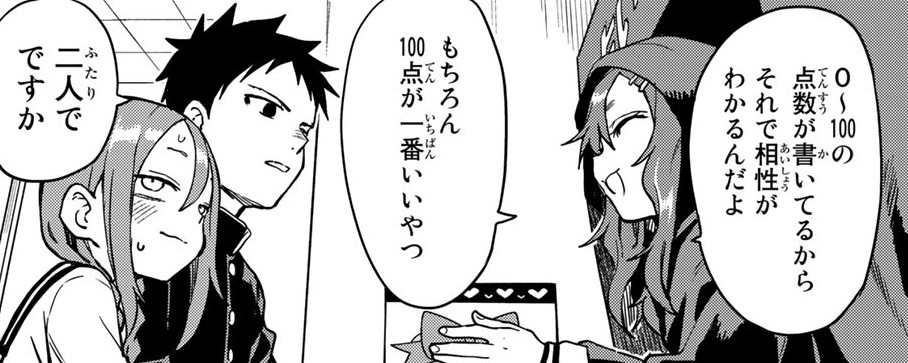
At the school festival, Ayumu and Urushi stop by the affinity fortune telling booth while Maki is on duty. Maki holds out a box with an opening on top, and says they need to pull out a single card together.
- マキ:
- 「0〜100の点数が書いてるからそれで相性がわかるんだよ」
- “Your compatibility is determined by the score written from 0 to 100.”
- Literal: “Since a score from 0 to 100 is written there, you can tell your compatibility from that.”
- 「もちろん100点が一番いいやつ」
- “Of course, 100 points is the best score.”
- 歩:
- 「二人でですか?」
- “Together?”
Key Points
- 相性 describes how well two people, things, or personalities fit together.
- In this booth, the card score is treated as a measure of Ayumu and Urushi’s romantic compatibility.
- それで refers to the number written on the card.
- The idea is that their compatibility will be known by means of that score.
- んだよ gives an explanatory tone, as Maki tells them the rule of the fortune-telling.
- The よ adds that she is presenting information they need to know.
- Ayumu is checking whether they must draw the card together.
- The で marks the manner or grouping: “as two people” or “together”.
Vocabulary
| Word | English | Meaning |
|---|---|---|
| 点数 | Score | 点数 is the number of points earned, such as a score on a test or in a game. |
| 書く | To write | 書く is to write letters or words. |
| 相性 | Compatibility | 相性 means compatibility between people or things, whether their qualities work well together. |
| わかる | To understand | わかる is to understand something, or for something to become known or clear. It is also written 分かる. |
| もちろん | Of course | もちろん describes something so natural that it goes without saying. |
| 一番 | Number one | 一番 means number one, first, or best. As an adverb, it means “most”. |
| いい | Good | いい describes something good, nice, or fine. It can also mean “okay” or “that’s enough”. Its other forms come from よい, as in よくない and よかった. |
| やつ | Guy | やつ is a casual word for a person or thing. It can sound rough or friendly, depending on the speaker. It is also written 奴. |
| 二人 | Two people | 二人 means two people. |
See Also
- Kanji: Mutuality and appearance with 相
- Grammar: Reasoning with 〜のだ
- Grammar: Marking the subject with が
- Grammar: Informing with よ
- Kanji: Nature and identity with 性
- Kanji: People and persons with 人