Cooking rice for whoever comes home with ご飯を炊く
Vocabulary Explanation: Collocations for cooking
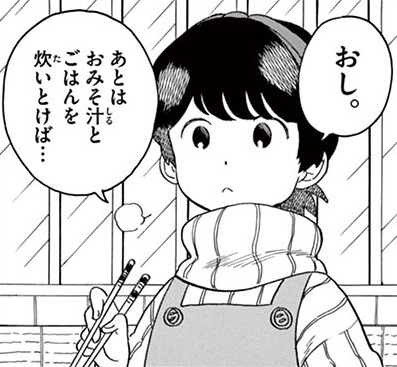
During the spring dance performances, everyone at the house keeps a different schedule, so they each eat when they can. Kiyo comes home from shopping, sees that the rice balls she left out have been eaten, and makes a set of side dishes that taste fine even cold.
- キヨ:
- 「おし。」
- “All right.”
- 「あとはおみそ汁とごはんを炊いとけば...」
- “Now if I just make the miso soup and cook the rice...”
- Literal: “As for the rest, if I make miso soup and cook rice in advance...”
Key Points
- 炊く is the verb for cooking rice, in a pot or a rice cooker. English says “cook” or “make” rice, but Japanese uses this verb and almost never 作る. Kiyo writes ごはん in kana here, a common spelling of ご飯.
- 米を炊く names the raw grain going in, and ご飯を炊く names the cooked rice that comes out. Both are normal.
- Strictly, 炊く fits only ごはん. Miso soup would normally take 作る. Kiyo lists both jobs and lets the one verb carry them, as people do when running through what’s left to do.
- 〜とく is the casual contraction of 〜ておく, doing something ahead of a later need. Everyone at the house will come home hungry at different times, so Kiyo is getting the meal ready before they arrive.
- おく is a godan verb, so its ば form is おけば. The contracted form follows the same pattern: 炊いておけば becomes 炊いとけば.
- あと means “the rest” or “after”. あとは introduces the last tasks on a list: “now all that’s left is…”
- The ば clause names what it will take to finish. Kiyo trails off before the result, something like 完成だ, “and it’s done”. あとは〜ば is a common way to say that only these steps remain.
Vocabulary
あと (After)
あと is the time after something, the space behind something, or what remains. At the start of a sentence, it adds one more point, like “also”. It is also written 後.
みそ汁 (Miso soup)
みそ汁 is soup made by dissolving miso paste in stock, a standard part of an everyday Japanese meal. It is often said with a polite お, as おみそ汁, and is also written 味噌汁.
ごはん (Rice)
ごはん is cooked rice, and by extension a meal in general. It is also written ご飯.
炊く (To cook rice)
炊く is to cook rice or other grains by boiling them until the water is absorbed, as in ご飯を炊く. In western Japan, it also means to simmer other foods.
おく (To do in advance)
おく after a て-form verb means doing something now so it’s done or ready for later. In casual speech, 〜ておく contracts to 〜とく. On its own, it is 置く, “to put”.
See Also
- Vocabulary: Collocations for cooking
- Grammar: Doing in advance with 〜ておく
- Grammar: Hypothetical condition with 〜ば
- Grammar: How casual contractions work