Correcting a case of mistaken identity with 訂正
Kanji Explanation: Correction and revision with 訂 (Future entry)
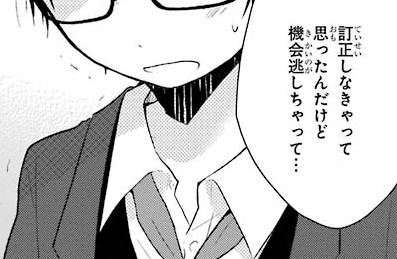
While Sana is away with her other friends for a moment, Ayumu leaves to use the restroom. Shun takes off his glasses to rub something from his eye, only for Sana to return and mistake him for Ayumu. He doesn’t correct her, but when Sana asks where Shun is, Shun says the restroom, and goes that way himself to wash his eye. In the restroom, Shun finds Ayumu and is about to explain what happened, but stops himself. Ayumu says it’s better not to hold back, and that Shun can say anything to him. Shun finally explains that Sana mistook him for Ayumu.
- 駿:
- 「訂正しなきゃって思ったんだけど機会逃しちゃって…」
- “I thought I should correct it, but I missed the chance…”
- Literal: “I thought, 'I have to correct this,' but I missed the chance...”
Key Points
- In this scene, 訂正する means correcting Sana’s misunderstanding after she mistook Shun for Ayumu.
- The kanji 訂 points to fixing or revising something that was wrong, so 訂正 fits “set the record straight” better than a vague “say something”.
- 「しなきゃ」 is a casual contraction of しなければいけない / しなければならない, meaning “have to do”.
- Here 訂正しなきゃ means “I have to correct it”, with an internal sense of obligation rather than a formal rule.
- The って marks the content of his thought in casual speech: “I thought, ‘I need to correct it.’”
- 「機会を 逃しちゃって」 is the fuller idea; the object marker を is omitted in casual speech.
- 「〜ちゃって」 adds a regretful or uncontrolled feeling here: he ended up missing the chance.
Vocabulary
訂正 (Correction)
訂正 means correcting an error in words, data, or an earlier statement.
思う (Think)
思う means to think, feel, believe, expect, or hope.
機会 (Opportunity)
機会 means an opportunity, chance, or suitable occasion.
See Also
- Future entry: Past tense with 〜た・〜だ
- Grammar: Must do with 〜なければならない
- Grammar: Doing completely or ending up doing with 〜てしまう and 〜ちゃう
- Kanji: Meeting and joining with 会