Costume for catching a Clow Card with 衣装
Kanji Explanation: Clothing and garments with 衣 (Future entry)
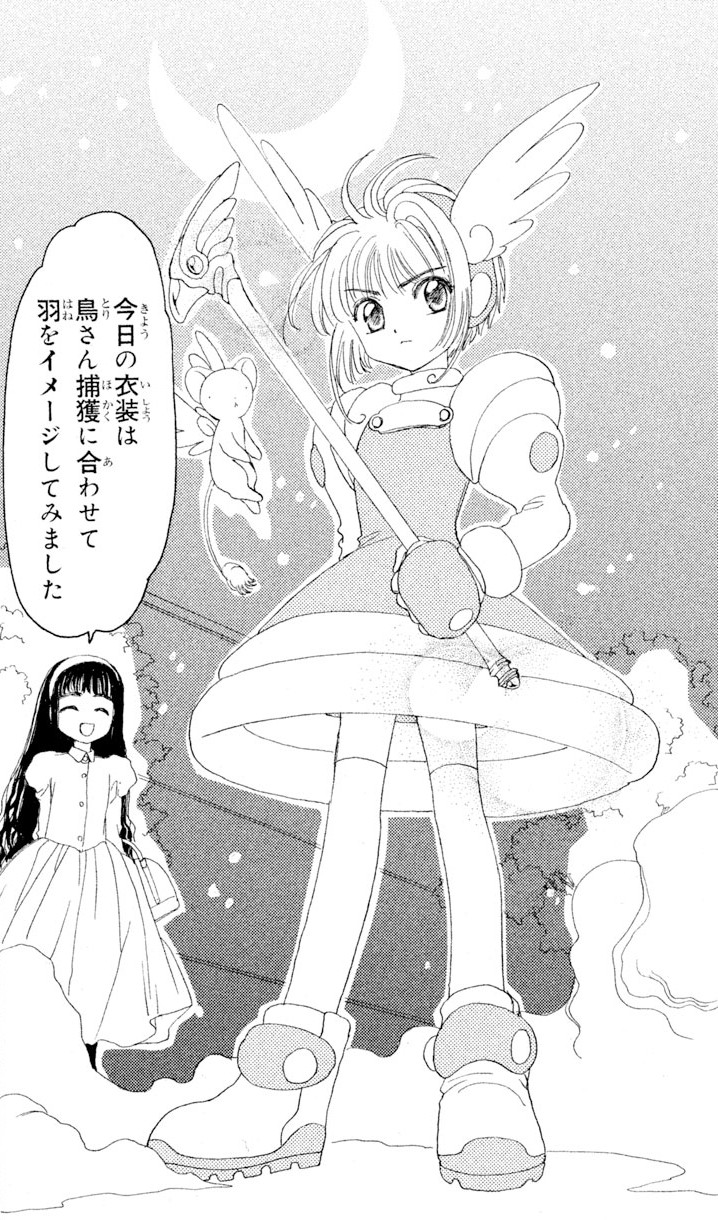
A magical bird appears at Sakura’s school and causes trouble with strong winds. Recognizing it as a Clow Card, Sakura returns at night to try to capture it. After she fails, she returns the next night to try again, sporting a new Cardcaptor outfit designed by her friend Tomoyo.
- 知世:
- 「今日の衣装は鳥さん捕獲に合わせて羽をイメージしてみました」
- “For today's outfit, I went with a feather-inspired look to match the bird-catching theme.”
- Literal: “For today's outfit, I tried imagining feathers to match catching a bird.”
Key Points
- Here 衣装 refers to the special Cardcaptor costume Tomoyo made for Sakura, not ordinary everyday clothes.
- The kanji 衣 points to clothing, while 装 adds the sense of dressing up or outfitting.
- 今日の衣装は means “as for today’s outfit”, introducing the design Tomoyo is presenting.
- The rest of the sentence explains the concept behind that outfit.
- The use of は sets it apart from the different costume Sakura wore the prior night.
- Ⓐに合わせて means “in line with Ⓐ” or “to match Ⓐ”.
- Here it links the costume design to the specific job of catching the bird.
- 羽 means “feather” or “wing”, so Tomoyo is saying she designed the look around that image.
- 〜てみました means “I tried doing…” and keeps her explanation polite, modest, and presentation-like.
Vocabulary
今日 (Today)
今日 means today. In formal writing, it can also mean the present day or current era.
衣装 (Costume)
衣装 means clothing, especially a costume for theater or dance, or formal clothes for an occasion.
鳥 (Bird)
鳥 means bird, an animal with feathers and wings.
捕獲 (Capture)
捕獲 means capturing a wild animal alive or catching a fleeing person.
羽 (Wing)
羽 means a feather or wing. The reading 羽 is a counter for birds, rabbits, and similar animals.
見る (To see)
見る means to see or look at something. It can also mean to examine its condition or nature.
See Also
- Future entry: Past tense with 〜た・〜だ
- Grammar: Marking the topic with は and も
- Kanji: Attire and equipment with 装
- Kanji: Now and the present with 今