Creating a report with 作成
Kanji Explanation: Becoming and accomplishing with 成
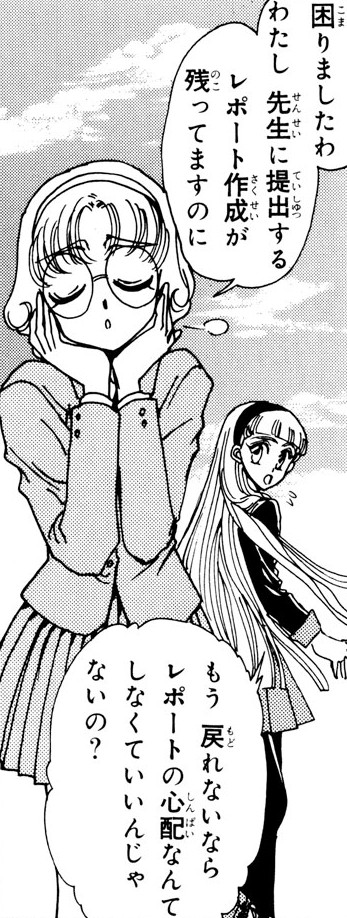
Fuu finds herself spirited away to another world, along with two other girls. A wizard appears before them, saying they cannot return home until they accomplish a specific goal.
- 風:
- 「困りましたわ。 わたし 先生に提出するレポート作成が残ってますのに」
- “Oh dear. I've still got to write that report to hand in to the teacher...”
- Literal: “Oh dear. Even though I still have report creation left to submit to the teacher...”
- 海:
- 「もう 戻れないならレポートの心配なんてしなくていいんじゃないの?」
- “If we can't go back anyway, isn't there no point worrying about the report?”
Key Points
- With レポート, it refers to producing the report as a completed piece of work.
- Japanese comfortably says レポート作成 even though English usually says write a report.
- 〜が残ってます means something still remains to be done.
- 困りましたわ sounds refined and flustered rather than bluntly upset.
- The sentence-final 〜のに expresses frustration because she still has this obligation hanging over her.
Vocabulary
| Word | English | Meaning |
|---|---|---|
| 困る | To be troubled | 困る is to be in a difficult situation without knowing what to do. |
| わたし | I | わたし is the most common word for “I”, used by anyone in polite speech and by women in casual speech. It is also written 私. |
| 先生 | Teacher | 先生 is a respectful title for teachers and certain professionals, including doctors, lawyers, and politicians. Speakers do not normally use it for themselves. |
| 提出 | Submission | 提出 is handing in something, such as homework, a report, or a form. |
| レポート | Report | レポート is a written report, such as a school paper. |
| 作成 | Creation | 作成 means creating or preparing something (such as a document or data) in a finished, usable form. |
| 残る | To remain | 残る is for something to be left over after the rest is gone. |
| もう | Already | もう means something has already happened, or with a negative, “no longer”. Before a number, it means “more”. Said alone, it shows frustration. |
| 戻る | Return | 戻る is to go back to where one was, or to return to an earlier state. |
| 心配 | Worry | 心配 means worry, concern, or anxiety about what might go wrong. With する, it means “to worry”. |
| なんて | Such a thing as | なんて follows a word to treat it lightly or with surprise: “things like” or “such a thing as”. At the start of a phrase, it means “what a…!” |
| する | To do | する is to do or perform something. It also turns many nouns into verbs, as in 勉強する. |
See Also
- Kanji: Becoming and accomplishing with 成
- Grammar: If that's the case with なら
- Grammar: Even though with 〜のに
- Grammar: Past tense with 〜た・〜だ
- Grammar: Permission to do with 〜てもいい
- Grammar: Able to do with 〜れる・〜られる
- Grammar: Polite style with です and ます
- Grammar: Reasoning with 〜のだ
- Kanji: Distribution and arrangement with 配
- Kanji: Going out and emerging with 出
- Kanji: Making and creating things with 作