Dazed by a wristwatch with 気が遠くなる
Idiom Explanation: Becoming lightheaded with 気が遠くなる
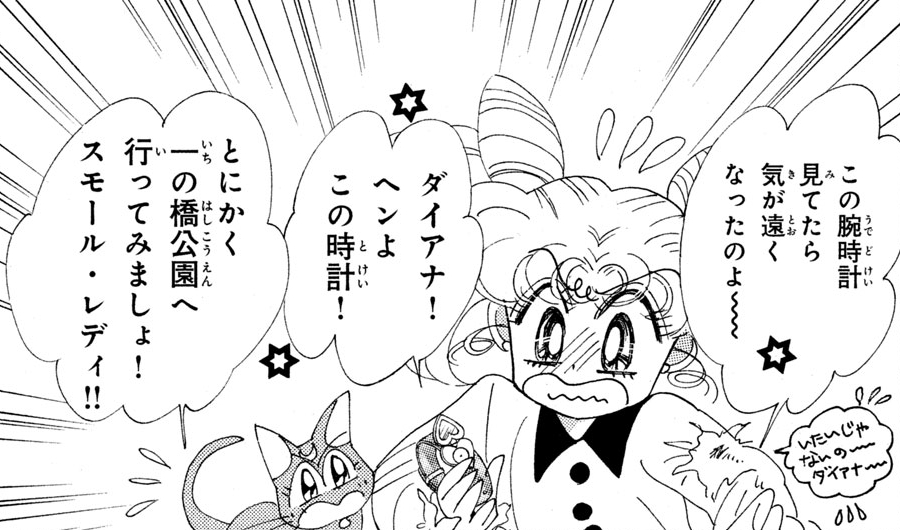
At the stroke of midnight, Chibiusa wakes to a mysterious glow from her new wristwatch. She gets out of bed in a daze, and begins to leave the room. Her cat, Diana, bites her on the arm, returning Chibiusa from her trance.
- ちびうさ:
- 「この腕時計見てたら気が遠くなったのよ〰〰」
- “When I looked at this wristwatch, I became lightheaded〰”
- Literal: “When I looked at this wristwatch, my spirit became distant〰〰”
- 「ダイアナ! ヘンよ この時計!」
- “Diana! Something is strange about this watch!”
- 「とにかく 一の橋公園へ行ってみましょ! スモール・レディ!!」
- “Anyway, let's try going to Ichinohashi Park! Small Lady!!”
Key Points
- The idiom describes consciousness feeling distant, like becoming lightheaded.
- In this scene it matches Chibiusa’s trance-like reaction to the glowing wristwatch.
- 見てたら is casual for 見ていたら, meaning when I was looking.
- The watch is the thing she was looking at when the dazed state came over her.
- ヘン is a casual way to say something is strange or off.
- 行ってみる means to try going or go and see.
- ましょ is a shortened form of the volitional ましょう.
Vocabulary
この (This)
この means “this” or “these” and comes directly before a noun. It points to something near the speaker or something the speaker is referring to in the conversation.
腕時計 (Wristwatch)
腕時計 means a wristwatch.
見る (To see)
見る means to see or look at something. It can also mean to examine its condition or nature.
時計 (Clock)
時計 means a clock, watch, or other device that measures and displays time.
行く (To go)
行く means to go or move toward a place away from the speaker.
See Also
- Idiom: Becoming lightheaded with 気が遠くなる
- Future entry: If and when with 〜たら
- Grammar: Ongoing actions and resulting states with 〜ている
- Grammar: Trying it out with 〜てみる
- Future entry: Past tense with 〜た・〜だ
- Kanji: Counting and planning with 計
- Kanji: Enclosed grounds and gardens with 園
- Kanji: Time and occasions with 時