Deep-sea fishing with 遠洋漁業
Kanji Explanation: Fishing and catches with 漁
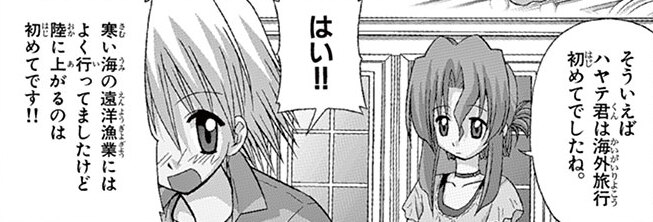
Over Golden Week, Hayate, Nagi, and Maria have come to the Aegean Sea on vacation. Hayate leans over the balcony railing, thrilled at the view. He has worked jobs among adults since he was a small child.
- マリア:
- 「そういえばハヤテ君は海外旅行初めてでしたね。」
- “Come to think of it, Hayate, this is your first trip abroad, isn't it?”
- ハヤテ:
- 「はい!!」
- “Yes!!”
- 「寒い海の遠洋漁業にはよく行ってましたけど陸に上がるのは初めてです!!」
- “I used to go out on deep-sea fishing trips in cold waters all the time, but this is my first time going ashore!!”
Key Points
- 遠洋 is the ocean far from land, from 遠, “far”, and 洋, “ocean”. 漁業 is the fishing industry. Together they name fishing operations that travel to distant waters for weeks or months.
- Japanese fisheries divide fishing by distance from shore. 沿岸漁業 works along the coast, and 沖合漁業 works offshore. 遠洋漁業 goes the farthest out.
- 陸 is land as opposed to sea, and 上がる means to go up onto something. 陸に上がる is what sailors do when they leave the ship.
- 陸に上がるのは初めてです uses の to turn the action into a subject: “going ashore is a first”.
- 行ってました is 行っていました with the い dropped, a common contraction in speech. 〜ていた with よく, “often”, describes something he did repeatedly in the past.
- けど sets the familiar part, trips out to sea, against the new part, setting foot on land.
- Maria says 初めてでしたね in the past tense even though she’s talking about now. The past form here means she has just remembered something she already knew, and ね asks Hayate to confirm it.
Vocabulary
| Word | English | Meaning |
|---|---|---|
| そういえば | Come to think of it | そういえば brings up something the speaker has just been reminded of, like “come to think of it” or “speaking of which”. It often opens a change of subject. |
| 君 | You | 君 is a word for “you” used toward equals or people younger or of lower standing. It sounds gentle or poetic. Read くん, it is a suffix on names. |
| 海外旅行 | Overseas travel | 海外旅行 is a trip to another country. To Japanese speakers, going abroad means crossing the sea, so 海外 means “overseas”. |
| 初めて | For the first time | 初めて describes doing something for the first time. |
| 寒い | Cold | 寒い describes cold weather or air, or feeling cold. |
| 海 | Sea | 海 is the sea or ocean, the large body of salt water that covers much of the earth. |
| 遠洋漁業 | Deep-sea fishing | 遠洋漁業 is fishing on the open ocean far from the home coast, with voyages that can last weeks or months. It contrasts with coastal and offshore fishing. |
| よく | Often | よく means something happens often. It also means “well” or “skillfully”. Before 〜ね, it can show admiration or surprise. |
| 行く | To go | 行く means to go or move toward a place away from the speaker. |
| 陸 | Land | 陸 is land, as opposed to sea or water. 陸に上がる means to go ashore. |
| 上がる | To rise | 上がる is to go up, or to rise in level. It also means voices are raised, or for someone to enter a house. |
See Also
- Kanji: Fishing and catches with 漁
- Grammar: Ongoing actions and resulting states with 〜ている
- Grammar: But with 〜けど and 〜けれど
- Grammar: Seeking agreement with ね
- Grammar: How casual contractions work
- Grammar: Polite style with です and ます
- Kanji: Going and carrying out with 行
- Kanji: Work and vocation with 業