Demolishing the movie theater with 解体
Kanji Explanation: Separating and understanding with 解
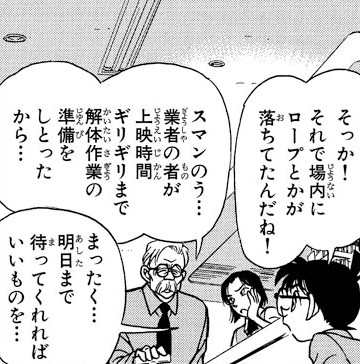
Conan and his friends go to the theater to see a movie. There, they discover this is the last day before the theater closes.
- コナン:
- 「そっか!それで場内にロープとかが落ちてたんだね!」
- “Oh, I see! That's why there were ropes and stuff lying around the venue!”
- オーナー:
- 「スマンのう… 業者の者が上映時間ギリギリまで解体作業の準備をしとったから…」
- “Sorry about that... The contractor's crew was rushing to get the dismantling ready right up until showtime...”
- Literal: “Sorry... Because the contractor's people were preparing the dismantling work right up until the screening time...”
- スタッフ:
- 「まったく… 明日まで待ってくれればいいものを…」
- “Honestly... They could've at least waited until tomorrow...”
Key Points
- In this scene 解体 refers to demolition work on the movie theater.
- It is about taking a structure apart, not simply “disassembling” a small object.
- The full phrase means the work of dismantling or tearing the place down.
- 上映時間ギリギリまで means “right up until showtime”.
- It emphasizes how close to the last possible moment they were preparing.
- それで at the start of a sentence refers back to something previously said and introduces the result, much like “so” or “therefore” or “and then”.
Vocabulary
| Word | English | Meaning |
|---|---|---|
| 場内 | Inside the venue | 場内 means inside a venue or within its grounds. It can refer to the interior of a hall, theater, stadium, or similar place. |
| ロープ | Rope | ロープ is a rope. |
| 落ちる | To fall | 落ちる is to drop from a higher place. It also means for a fire to die down, or to fail an exam. |
| 業者 | Contractor | 業者 means a business, contractor, supplier, or dealer. The best English term depends on the service or trade involved. |
| 者 | Person | 者 is a person. It is a formal or rough word, as in 部下の者, “one of my men”. |
| 上映時間 | Screening time | 上映時間 is how long a film runs from start to finish. It can also mean the hour a showing begins. |
| ギリギリ | Barely | ギリギリ is a katakana spelling of ぎりぎり, “just barely” or “right up to the limit”. |
| 解体 | Dismantling | 解体 means taking something apart. It can refer to dismantling a machine, demolishing a building, disbanding an organization, or dissecting a body. |
| 作業 | Work | 作業 means work, a task, or an operation. It usually refers to practical activity carried out toward a specific result. |
| 準備 | Preparation | 準備 is getting ready for something ahead of time. |
| 明日 | Tomorrow | 明日 is the day after today. |
| 待つ | To wait | 待つ is to stay until someone comes or something happens. |
| いい | Good | いい describes something good, nice, or fine. It can also mean “okay” or “that’s enough”. Its other forms come from よい, as in よくない and よかった. |
See Also
- Kanji: Separating and understanding with 解
- Grammar: Past tense with 〜た・〜だ
- Grammar: Receiving kindness with 〜てくれる
- Grammar: Until an action occurs with 〜まで
- Grammar: Reasoning with 〜のだ
- Grammar: Grammar in the Kansai dialect
- Future entry: Transitivity in Japanese
- Grammar: Seeking agreement with ね
- Grammar: Hypothetical condition with 〜ば
- Kanji: Body and substance with 体
- Kanji: Making and creating things with 作
- Kanji: Spaces and intervals with 間
- Kanji: Time and occasions with 時
- Kanji: Work and vocation with 業