Did you tell her about me with 〜のこと話す
Grammar Explanation: Referring to a person with 〜のこと
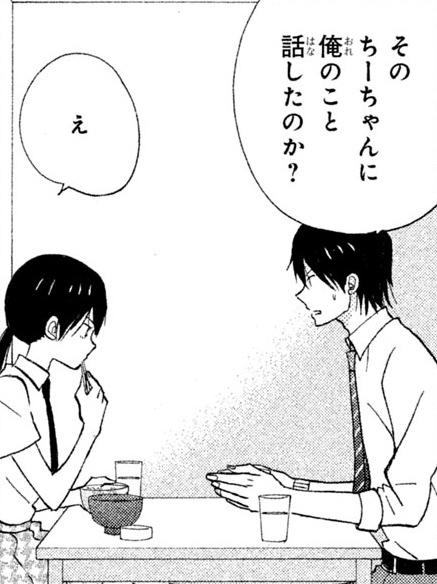
Mao has been learning to cook from her friend Chi. She made dinner, but Hiro’s portion alone had yogurt, jam, and gum in it as a “secret ingredient”. When Hiro demands to know why, Mao explains that Chi suggested it after Mao told her that Hiro likes sweet things.
- 基:
- 「その ちーちゃんに俺のこと話したのか?」
- “So you told this Chi about me?”
- 真魚:
- 「え」
- “Huh?”
Key Points
- 話す needs のこと to take a person. ×俺を話した doesn’t work, because you talk about things to do with a person, not the person.
- Here のこと means “about”, so 俺について話した would also work. The full form is 俺のことを話した, with the を dropped.
- に marks the person Mao told: “(told) Chi”.
- その means “that”, for someone the other person just brought up: “this Chi you mentioned”.
- のか asks about something he’s just pieced together from what Mao said. It’s a casual, male-sounding way to ask “so you did…?”
Vocabulary
その (That)
その points to something near the listener or to something just mentioned. Said alone, it fills a pause, like “um”.
俺 (I)
俺 means “I” or “me”. Men commonly use it in casual speech, and it sounds rougher and more masculine than 私 or 僕.
こと (Thing)
こと is an abstract thing, matter, or fact, as opposed to a physical object. It also turns a verb phrase into a noun, as in 見たことがある. It is also written 事.
話す (To talk)
話す is to talk or speak. It also means to tell someone something.
See Also
- Grammar: Referring to a person with 〜のこと