Difficult to pass on with 〜がたい
Grammar Explanation: Difficult to do with 〜がたい
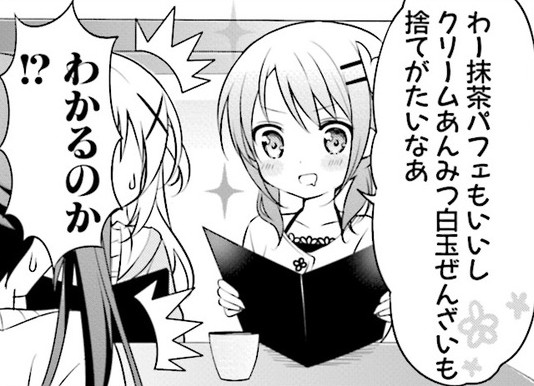
Visiting her new friend’s family’s café, Cocoa ponders over which menu item to order.
- ココア:
- 「わー抹茶パフェもいいし クリームあんみつ白玉ぜんざいも 捨てがたいなあ」
- “Wow, the green tea parfait is good, but the cream anmitsu and dumpling red bean soup are difficult to pass on.”
- Literal: “Wow, the green tea parfait is good, and the cream anmitsu and dumpling red bean soup is also difficult to throw away.”
- リゼ:
- 「わかるのか!?」
- “You understand that!?”
Key Points
- Cocoa is not discussing throwing food away; she finds the other desserts too appealing to pass up.
- The verb becomes 捨て, and がたい describes strong psychological reluctance rather than physical difficulty.
- も adds the anmitsu and zenzai to the tempting parfait, while なあ lets her indecision trail off.
- Rize is not neutrally asking whether Cocoa understands. Final のか makes her surprised reaction blunt.
Vocabulary
| Word | English | Meaning |
|---|---|---|
| 抹茶 | Green tea | 抹茶 is a finely powdered green tea whisked with hot water or used to flavor foods and sweets. |
| パフェ | Parfait | パフェ is a parfait, a tall glass of ice cream, fruit, and sweet toppings. |
| いい | Good | いい describes something good, nice, or fine. It can also mean “okay” or “that’s enough”. Its other forms come from よい, as in よくない and よかった. |
| クリーム | Cream | クリーム is cream, such as whipped cream or skin cream. |
| あんみつ | Anmitsu | あんみつ is a Japanese dessert of agar jelly cubes, sweet bean paste, fruit, and syrup. |
| 白玉 | White dumpling | 白玉 means a small white rice-flour dumpling, often served in sweets. |
| 捨てる | To throw away | 捨てる is to throw something away. 捨てがたい means hard to give up. |
| わかる | To understand | わかる is to understand something, or for something to become known or clear. It is also written 分かる. |
See Also
- Grammar: Difficult to do with 〜がたい
- Grammar: Marking the topic with は and も
- Grammar: Consonant doubling with 促音
- Kanji: Tea and tea culture with 茶