Disbanding a music group with 解散
Kanji Explanation: Separating and understanding with 解
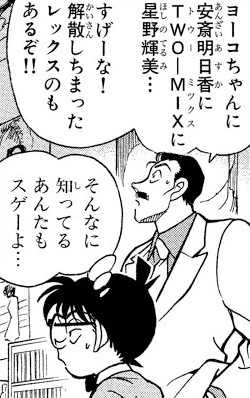
Detective Kogoro gives a young woman a ride home in exchange for concert tickets. While waiting for her to get the tickets, Kogoro notices the livingroom is filled with pop star posters.
- 小五郎:
- 「ヨーコちゃんに安斎明日香にTWO―MIXに星野輝美…」
- “There's Yoko, and Asuka Anzai, and Two-Mix, and Terumi Hoshino...”
- Literal: “Yoko-chan, and Asuka Anzai, and TWO-MIX, and Terumi Hoshino...”
- 「すげーな!解散しちまったレックスのもあるぞ!!」
- “Amazing! There's even the disbanded group Lex!”
- Literal: “Amazing! There are even ones of Lex, who went and disbanded!!”
- コナン:
- 「そんなに知ってるあんたもスゲーよ…」
- “It's also amazing that you know that much about them...”
- Literal: “You knowing that much is amazing too...”
Key Points
- Here 解散 means the band Lex has disbanded.
- It is used for organizations, groups, and teams splitting up or being dissolved.
- 解散しちまった is a contracted spoken form of 解散してしまった.
- In this line it gives a rough, conversational feel: “they went and broke up”.
- The omitted noun after の is something like poster or item.
- Kogoro is saying there is even memorabilia from a band that has already broken up.
- ちゃん is an affectionate, informal suffix attached to names, used mainly for children, close friends, and family members.
Vocabulary
| Word | English | Meaning |
|---|---|---|
| 解散 | Dissolution | 解散 means dispersing a group or formally dissolving an organization. |
| ある | To exist | ある is to exist or be in a place, for things and plants rather than people or animals. It also means to have something, or for an event to take place. |
| そんなに | That much | そんなに describes a degree like the one just mentioned. With a negative, it means “not that much”. |
| 知る | To know | 知る means to learn or come to know a fact or person. In the form 知っている, it describes already knowing. |
| あんた | You | あんた is a casual, blunt word for “you”. Between close people it sounds familiar, but toward others it can sound rude. |
See Also
- Kanji: Separating and understanding with 解
- Grammar: Past tense with 〜た・〜だ
- Grammar: Doing completely or ending up doing with 〜てしまう and 〜ちゃう
- Grammar: Marking the topic with は and も
- Grammar: Informing with よ
- Grammar: How casual contractions work
- Grammar: Rough declarations with ぞ and ぜ