Do you believe such about our customers with 〜でしょう
Grammar Explanation: Presuming with 〜だろう and 〜でしょう
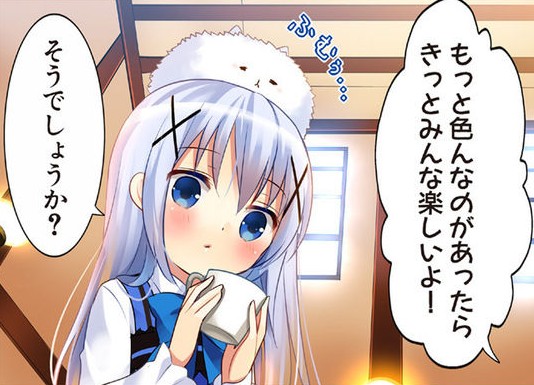
Cocoa points out the plainness of the cups at the Rabbit House café.
- ココア:
- 「もっと色んなのがあったらきっとみんな楽しいよ!」
- “I'm sure everyone would have fun if we had more kinds!”
- チノ:
- 「そうでしょうか?」
- “Do you think that's so?”
- Literal: “Is that so, I wonder?”
Key Points
- Chino uses でしょうか to ask whether Cocoa’s claim about happier customers is sound.
- The conjectural form leaves room for doubt, which fits Chino’s skeptical response.
- そう means “so” or “that way” here, pointing back to Cocoa’s prediction rather than describing a visible object.
- 〜たら means “if there were more kinds”. きっと and final よ make Cocoa sound confident about the result.
Vocabulary
| Word | English | Meaning |
|---|---|---|
| もっと | More | もっと describes a greater amount or degree than now, like “more” or “even more”. |
| 色んな | All sorts of | 色んな describes many different kinds. It is a casual form of 色々な. |
| ある | To exist | ある is to exist or be in a place, for things and plants rather than people or animals. It also means to have something, or for an event to take place. |
| きっと | Surely | きっと describes something the speaker feels sure will happen or is true. |
| みんな | Everyone | みんな means all the people in a group, or everything. It is also written 皆. |
| 楽しい | Fun | 楽しい describes something enjoyable, or the feeling of having fun. |
| そう | So | そう means “like that” or “that way”. Said alone, it agrees: “right”. After a verb stem or adjective, it means something looks or seems a certain way. |
See Also
- Grammar: Presuming with 〜だろう and 〜でしょう
- Grammar: If and when with 〜たら
- Grammar: Informing with よ