Do you dislike Fujimiya too with 〜のこと嫌い
Grammar Explanation: Referring to a person with 〜のこと
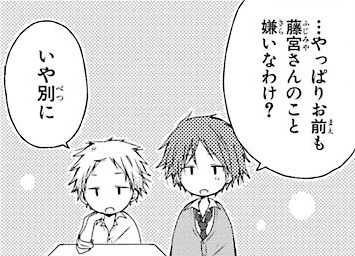
Hase wants to become friends with his classmate Fujimiya, but she keeps everyone at a distance, and the class has written her off as cold. Hase has been telling his friend Shogo about her.
- 長谷:
- 「…やっぱりお前も藤宮さんのこと嫌いなわけ?」
- “...So you don't like Fujimiya either?”
- Literal: “...So, as I thought, you dislike Fujimiya too?”
- 桐生:
- 「いや別に」
- “Nah, not really.”
Key Points
- のこと after 藤宮さん makes her the person the dislike is aimed at.
- The full form is 藤宮さんのことが嫌い, with the が dropped. Like 好き, 嫌い works with or without のこと: 藤宮さんが嫌い means the same thing.
- やっぱり means “as I thought” and も means “too”. Hase is bracing for Shogo to be one more person who has written Fujimiya off.
- わけ asks for the situation behind something: “so is that how it is?” After the na-adjective 嫌い, な links it to わけ.
- Asked with a rising tone, 〜なわけ? is casual and a little pointed.
- 別に with the negative left unsaid means “not particularly”. Shogo doesn’t dislike her. He just doesn’t care either way.
Vocabulary
やっぱり (As expected)
やっぱり shows that something turned out as the speaker thought, or that the speaker is coming back to an earlier choice: “after all”.
お前 (You)
お前 is a casual, rough word for “you”. Men often use it toward people of equal or lower standing.
こと (Thing)
こと is an abstract thing, matter, or fact, as opposed to a physical object. It also turns a verb phrase into a noun, as in 見たことがある. It is also written 事.
嫌い (Disliked)
嫌い describes something a person dislikes or hates. After a noun, as in タバコ嫌い, it is read ぎらい and describes someone who can’t stand that thing.
わけ (Reason)
わけ is a reason or meaning. It also appears in grammar patterns such as わけがない, “there’s no way”, and わけにはいかない, “can’t very well”.
いや (false)
いや is used to deny something or to hesitate, like “no” or “well…”. It also describes something unpleasant or unwanted, often written 嫌.
別に (Not particularly)
別に means “not particularly” when used with a negative. Said alone, it means “nothing in particular” or “it doesn’t matter”.
See Also
- Grammar: Referring to a person with 〜のこと