Doing as you please is strictly forbidden with 〜べからず
Grammar Explanation: Strongly forbidden with 〜べからず
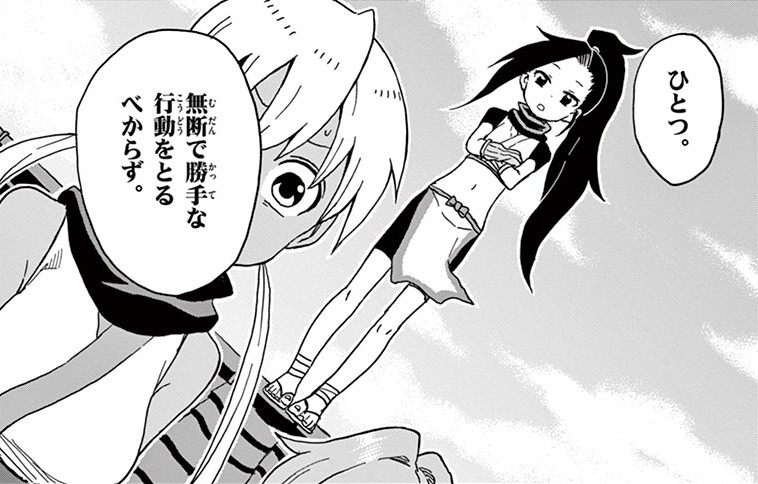
Sazanka sneaks out of class, leaving the teacher to send Asagao to bring her back. As Asagao chases Sazanka across the rooftops near the upper grade classroom, Tsubaki spots them. She meets them up on the roof and recites the school’s first rule.
- ツバキ:
- 「ひとつ。無断で勝手な行動をとるべからず。」
- “One: Doing as you please without permission is strictly forbidden.”
- Literal: “One. Taking selfish action without permission is not to be done.”
Key Points
1べからず = “must not / is strictly forbidden”
- Here とるべからず gives the line the feel of an official rule: “must not take such action” / “is strictly forbidden”.
- Pattern: [verb dictionary form] + べからず “must not [verb]”.
- A modern paraphrase here is 無断で勝手な行動をとってはいけない.
2What is being forbidden: 無断で勝手な行動をとる
- The whole phrase before べからず describes the prohibited behavior: taking self-directed action without permission.
- 無断で = “without permission, without authorization”.
- 勝手な行動 = “self-willed / arbitrary behavior”; not just any action, but acting on your own judgment.
3Sentence anatomy: [無断で] [勝手な行動] をとる
- 無断で modifies how the action is done, while 勝手な modifies 行動.
- A simplified core is 行動をとる “to take action / engage in behavior”.
- So the line builds from the noun phrase outward: unauthorized + self-directed + action.
4Formal rule-book tone: ひとつ。〜べからず。
- ひとつ。 introduces item one in a formal list of rules or precepts.
- Together with べからず, it makes Tsubaki sound like she is reciting a fixed code rather than speaking casually.
- That stiff, old-fashioned style matches the school-rule atmosphere of the scene.
Vocabulary
無断 (Without permission)
無断 means without permission or prior notice.
勝手 (One's own way)
勝手 means one’s own way or convenience. 勝手に often describes acting on one’s own, especially without permission or regard for others.
See Also
- Grammar: Strongly forbidden with 〜べからず
- Kanji: Absence and nothingness with 無
- Kanji: Cutting off and decision with 断
- Kanji: Hands and skill with 手
くノ一ツバキの胸の内 © its respective creators. It is used here for educational commentary.