Doing nothing but slack off with 〜てばっか
Grammar Explanation: Nothing but with 〜ばかり
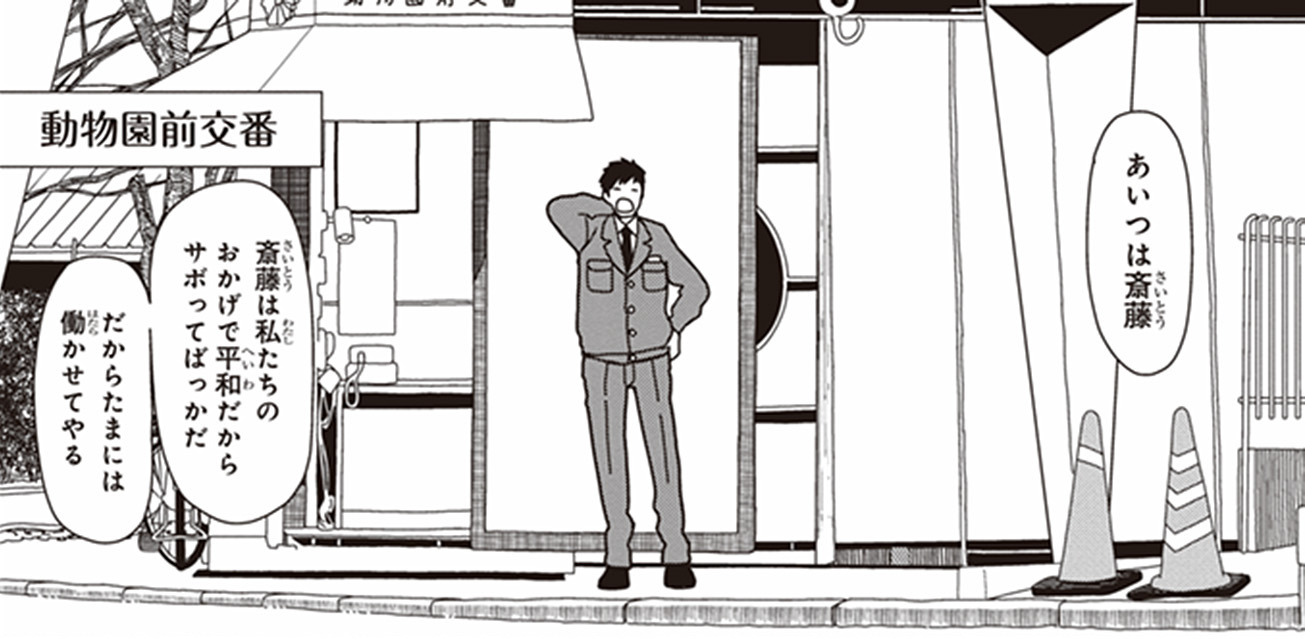
Yui, Sacchan, and Kotoha are making a video to introduce the Colors and the people of their town. After filming at a few local shops, they come to the police box by the zoo, where Officer Saitou works.
- 「動物園前交番」
- “Zoo-Front Police Box”
- さっちゃん:
- 「あいつは斎藤」
- “That guy is Saitou.”
- 「斎藤は私たちのおかげで平和だからサボってばっかだ」
- “Thanks to us, everything's peaceful, so Saitou does nothing but slack off.”
- 「だからたまには働かせてやる」
- “So for once, we're going to make him work.”
Key Points
- サボる means to slack off or skip work or class. It comes from サボ, short for サボタージュ, the French sabotage, with る added to make it a verb.
- The て-form サボって plus ばっか says slacking off is all Saitou does. ばっか is a casual, clipped form of ばかり, and だ closes the sentence. The fuller form is サボってばかりいる.
- The critical tone that ばかり often carries suits a complaint about a police officer doing nothing.
- おかげで means “thanks to” and credits someone with a good result. Sacchan says the town is peaceful thanks to the girls.
- から makes the peace the reason for Saitou’s slacking: with nothing happening, he has nothing to do.
- 働かせる is the causative of 働く, “to work”. It means “to make someone work”.
- 〜てやる is a rough version of 〜てあげる. Here Sacchan presents making Saitou work as a favor, the kind of favor he won’t welcome.
- たまには means “once in a while” or “for once”. The は contrasts this time with all the slacking.
- あいつ is a rough way to say “that guy”. Using it to introduce a police officer in their video shows how little respect Sacchan has for him.
- The sentence leaves off だ. Casual speech often drops it after a noun.
Vocabulary
動物園 (Zoo)
動物園 means a zoo, where animals are kept and displayed to the public.
前 (Front)
前 is the front of something. It also means an earlier time, as in 三年前, “three years ago”.
交番 (Police box)
交番 is a small neighborhood police station where officers are posted to watch over the area, help with directions, and take reports of lost items.
あいつ (That guy)
あいつ refers to a person who is not part of the conversation, or sometimes to a thing. It is casual and can sound rough or familiar.
私たち (We)
私たち means “we” or “us”. It is also written 私達.
おかげ (Thanks to)
おかげ is the help or influence someone or something gives. 〜のおかげ means “thanks to”. It is also written お陰.
平和 (Peace)
平和 means peace, without war, conflict, or disturbance.
サボる (To slack off)
サボる means to skip work, class, or a duty, or to slack off when you should be working. It comes from サボ, short for サボタージュ (sabotage).
たまに (Once in a while)
たまに means occasionally, not often. たまには is “once in a while” or “for once”, often for something that should happen more.
働く (To work)
働く is to work at a job.
やる (To do)
やる is a casual word for “to do”. It also means to give something to someone of lower standing, or to animals and plants.
See Also
- Grammar: Nothing but with 〜ばかり
- Grammar: Because with 〜から
- Grammar: Making and letting with 〜せる・〜させる
- Grammar: Doing for someone with 〜てあげる
- Kanji: Enclosed grounds and gardens with 園
- Kanji: Motion and activation with 動
- Kanji: Privacy and self with 私
- Kanji: Things and kinds with 物