Don't make such a thing with な
Grammar Explanation: The prohibitive な
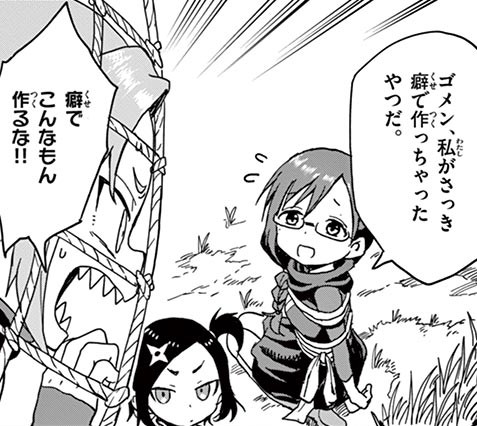
During a competition, Touwata and Mizubashou confront Tsubaki’s group to ask for help. While Touwata lays out her request, Sazanka and Asagao tie the two with ropes, believing their plea to be a trick. Figuring they’ve won, Sazanka and Asagao let down their guard and fall into a trap.
- ミズバショウ:
- 「ゴメン、私がさっき癖で作っちゃったやつだ。」
- “Sorry, I made that out of habit earlier.”
- サザンカ:
- 「癖でこんなもん作るな!!」
- “Don't make these things out of habit!”
- Literal: “Do not make this kind of thing out of habit!”
Key Points
1作るな = “Don’t make it!”
- Verb dictionary form + な is a blunt command telling someone not to do something.
- Here, 作るな is an irritated scolding, not a polite request.
2こんなもん = こんなもの, with a dismissive spoken tone
- もん is a casual spoken contraction of もの (“thing”).
- こんなもん means “stuff like this” / “something like this”.
- In an angry line like this, it sounds dismissive, more like “this kind of stuff” than a neutral “this item”.
3Dropped particle
- Sazanka’s response drops を: こんなもん(を)作るな.
Vocabulary
私 (I)
私 means “I” or “me”. It is the standard first-person pronoun in polite speech and is also common in casual speech among women.
作る (To make)
作る means to create or prepare something.
See Also
- Grammar: The prohibitive な
- Future entry: Past tense with 〜た・〜だ
- Grammar: The copula だ
- Grammar: Doing completely or ending up doing with 〜てしまう and 〜ちゃう
- Kanji: Privacy and self with 私
くノ一ツバキの胸の内 © its respective creators. It is used here for educational commentary.