Don't say it with 〜てはだめだ
Grammar Explanation: Must not do with 〜てはだめだ
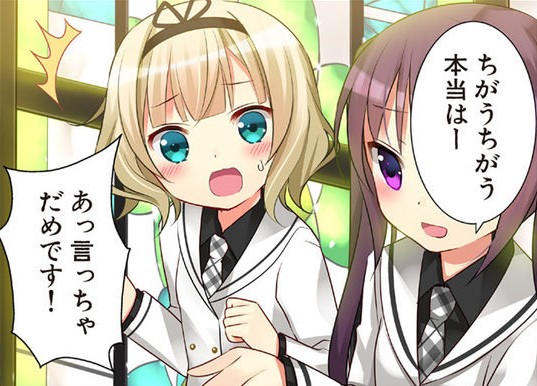
Syaro gives a vague account of her first meeting Rize, as the truth is too embarassing for her. Cocoa listens to Syaro’s words and misunderstands the event.
- リゼ:
- 「ちがうちがう本当はー」
- “No, no. What really happened was...”
- シャロ:
- 「あっ言っちゃだめです!」
- “Ah, don't say it!”
- Literal: “Ah, it is no good if you say it!”
Key Points
1言っちゃだめです tells Rize not to reveal it
- Syaro tries to stop Rize from giving the embarrassing true account of their first meeting.
2言っちゃ contracts 言っては
- The casual contraction combines with polite です, which fits Syaro’s urgent but respectful plea.
3あっ shows the interruption is immediate
- Syaro reacts as Rize prepares to speak, so the line functions as “wait, don’t say it!”
4本当は trails into the account Syaro interrupts
- Contrastive は marks what actually happened, and the long vowel shows Rize is about to continue.
Vocabulary
| Word | English | Meaning |
|---|---|---|
| ちがう | To differ | ちがう is to be different from something. It also means to be wrong. Said alone, it means “no, that’s not it”. It is also written 違う. |
| 本当 | Truth | 本当 is the truth, as opposed to a lie or a joke. ほんとう? asks “really?” |
| 言う | To say | 言う means to say or tell. It can also mean to call something by a particular name. |
| だめ | No good | だめ describes something useless, hopeless, or not allowed. Said alone, it means “no!” or “don’t!” It is also written 駄目. |
See Also
- Grammar: Must not do with 〜てはだめだ
- Kanji: Matching and appropriateness with 当
- Kanji: Origins and main things with 本
ご注文はうさぎですか? © its respective creators. It is used here for educational commentary.