Don't suspect only me with 〜だけ
Grammar Explanation: Limiting with 〜だけ
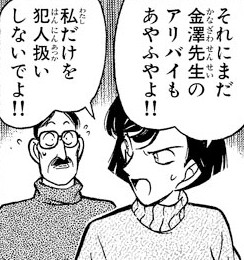
In a snow-covered mountain villa, a room full of suspects listen as Detective Mouri explains how their host was murdered. The accused notes she has a receipt showing she was at the convenience store at the bottom of the mountain when the murder took place.
- 中原:
- 「それにまだ金澤先生のアリバイもあやふやよ!!」
- “Moreover, Mr. Kanazawa's alibi is also vague!”
- 「私だけを犯人扱いしないでよ!!」
- “Don't treat only me as the suspect!”
- Literal: “Don't treat only me as the criminal!”
Key Points
- Here だけ limits the affected person to the speaker.
- She is protesting being singled out as the suspect.
- The object of 扱う is the person being treated in that way.
Vocabulary
| Word | English | Meaning |
|---|---|---|
| まだ | Still | まだ describes something that is still going on, or with a negative, something that has not happened yet. |
| 先生 | Teacher | 先生 is a respectful title for teachers and certain professionals, including doctors, lawyers, and politicians. Speakers do not normally use it for themselves. |
| アリバイ | Alibi | アリバイ is proof that a person was somewhere else when a crime took place. |
| あやふや | Vague | あやふや describes something unclear or uncertain, like a memory, an answer, or an alibi that cannot be relied on. |
| 私 | I | 私 means “I” or “me”. It is the standard first-person pronoun in polite speech and is also common in casual speech among women. |
| 犯人 | Criminal | 犯人 means the culprit or person who committed a crime. |
| 扱う | To treat | 扱う is to handle or deal with something. 〜扱いする means to treat someone as something, such as a suspect. |
| する | To do | する is to do or perform something. It also turns many nouns into verbs, as in 勉強する. |
See Also
- Grammar: Limiting with 〜だけ
- Grammar: In addition to with それに〜
- Grammar: Marking the topic with は and も
- Grammar: Negation with 〜ない
- Grammar: Informing with よ
- Grammar: Compound voicing with 連濁
- Grammar: Without doing and please don't with 〜ないで
- Kanji: Crimes and offenders with 犯
- Kanji: People and persons with 人
- Kanji: Privacy and self with 私