Don't underestimate bread-baking with 〜てはいけない
Grammar Explanation: Should not do with 〜てはいけない
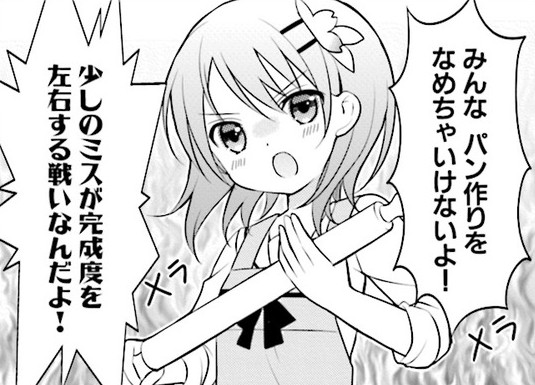
Cocoa prepares to teach her friends how to bake bread.
- ココア:
- 「みんな パン作りをなめちゃいけないよ!」
- “Everyone, don't underestimate bread making!”
- Literal: “Everyone, it must not be that you look down on bread making!”
- ◯:
- 「少しのミスが完成度を左右する戦いなんだよ!」
- “This is a battle where even a small mistake affects the final result!”
Key Points
1なめちゃいけない warns against underestimating bread making
- Cocoa says treating bread making with little respect would be wrong, giving the line the force of a warning.
2ちゃ contracts ては
- なめてはいけない becomes なめちゃいけない in casual speech.
3よ directs the lesson at the group
- みんな names Cocoa’s audience, and final よ presents the warning as information they need before starting.
4戦いなんだよ explains Cocoa’s warning
- なんだ presents bread making as a battle whose result depends on small mistakes, and よ presses that explanation on the group.
Vocabulary
| Word | English | Meaning |
|---|---|---|
| みんな | Everyone | みんな means all the people in a group, or everything. It is also written 皆. |
| パン | Bread | パン is bread, including rolls and pastries. |
| 作り | Making | 作り is the making of something, as in パン作り, bread making. It also means how something is built. |
| なめる | To lick | なめる is to lick something. It also means to look down on someone or not take something seriously. It is also written 舐める. |
| 少し | A little | 少し describes a small amount or degree. |
| ミス | Mistake | ミス is a mistake or error. |
| 完成度 | Degree of completion | 完成度 is how polished or complete a finished work is. |
| 左右 | Left and right | 左右 is left and right, both sides. As 左右する it means to decide how something turns out. |
| 戦い | Battle | 戦い is a fight or battle. It also means a contest or struggle. |
See Also
- Grammar: Should not do with 〜てはいけない
- Grammar: Reasoning with 〜のだ
- Grammar: Informing with よ
- Grammar: How casual contractions work
- Kanji: Becoming and accomplishing with 成
- Kanji: Making and creating things with 作
- Kanji: Measures and degrees with 度
ご注文はうさぎですか? © its respective creators. It is used here for educational commentary.