Drawing a conclusion about a murder with 結論
Kanji Explanation: Binding and results with 結
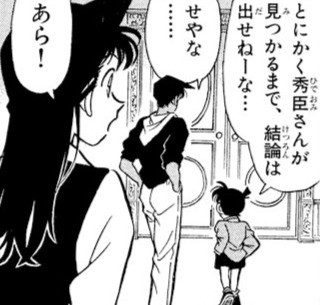
Conan and Heiji end up staying at the same mansion when a murder occurs. They decide to put their heads together to try and determine who the culprit is.
- コナン:
- 「とにかく秀臣さんが見つかるまで、結論は出せねーな…」
- “Anyway, I guess we can't come to a conclusion until we find Hideomi...”
- 平次:
- 「せやな……」
- “That's right.”
- 蘭:
- 「あら!」
- “Oh!”
Key Points
1結論を出す = “reach a conclusion”
- This set phrase describes settling on an answer after considering the evidence. Here, that answer is the murderer’s identity.
- Conan uses 結論は instead of 結論を. The topic marker は singles out the conclusion as the thing they cannot reach yet.
2秀臣さんが見つかるまで sets the endpoint
- 見つかる is intransitive, so が marks Hideomi as the person who is found. The translation uses the more natural English wording, “until we find Hideomi”.
- With the negative main clause 出せない, 〜まで〜ない means “not until”: they cannot draw a conclusion before Hideomi is found.
3出せねー is a rough negative potential form
- 出す becomes potential 出せる (“can reach”), then negative 出せない (“cannot reach”).
- Conan stretches ない into ねえ, written ねー, for blunt casual speech.
4Final な invites agreement
- Conan’s な makes the statement sound like a conclusion he expects Heiji to share, not the prohibitive な in commands such as 触るな.
- Heiji confirms it with Kansai せやな, the counterpart of standard そうだな: “Yeah, that’s right.”
Vocabulary
結論 (Conclusion)
結論 means a conclusion reached through reasoning, discussion, or examination of facts.
See Also
- Kanji: Binding and results with 結
- Future entry: Able to do with 〜れる・〜られる
- Grammar: Until an action occurs with 〜まで
- Future entry: How casual contractions work
- Grammar: Marking the topic with は and も
- Grammar: Grammar in the Kansai dialect
名探偵コナン © its respective creators. It is used here for educational commentary.